
Why Everyone Is Talking About Business vs Job
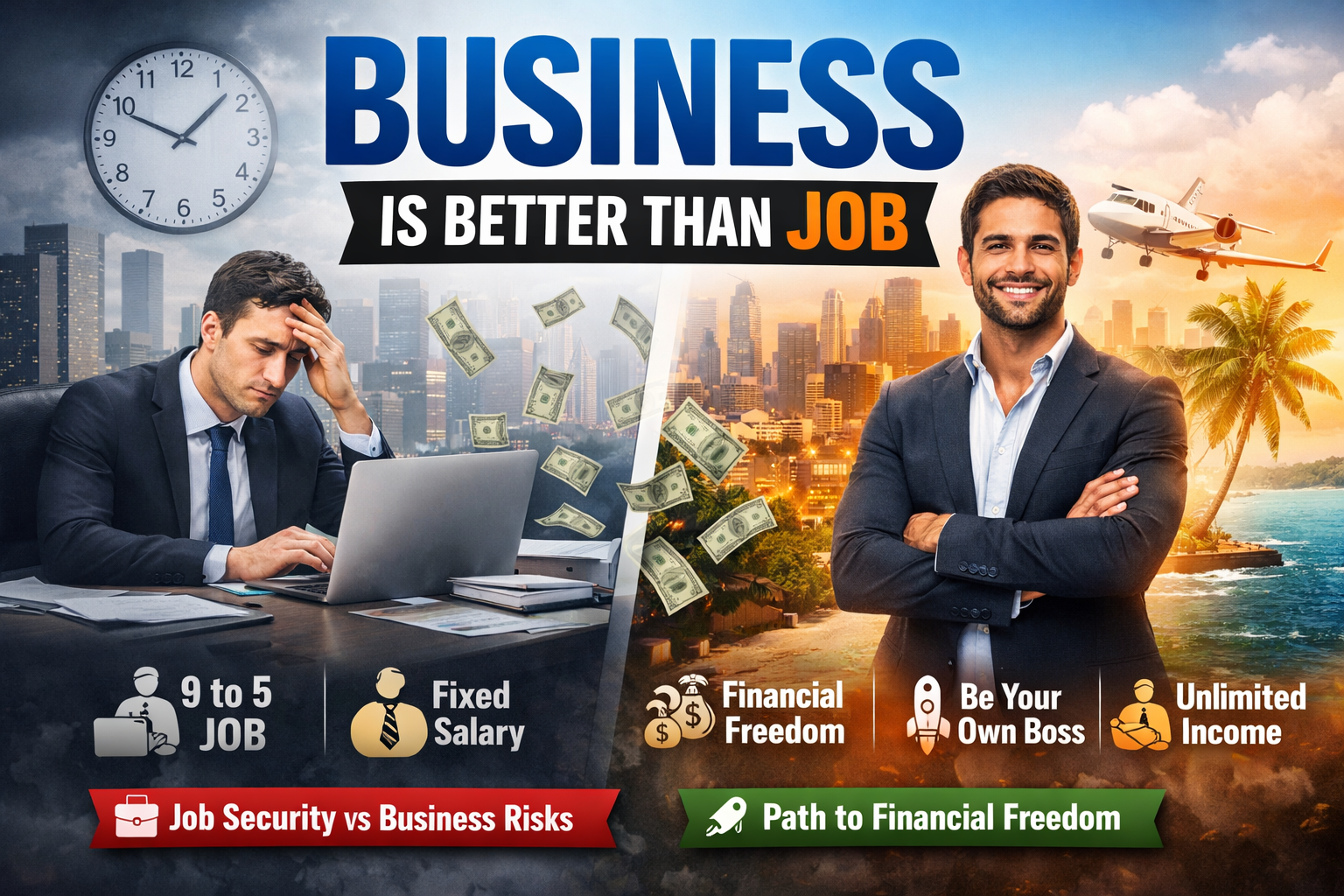
Many people believe that a job is the safest and smartest way to live a successful life. Society teaches us to study hard, get a degree, find a secure job, and work until retirement. But today, this old mindset is changing very fast. More people are now realizing that depending only on a salary may not be enough to achieve real financial freedom. That is why the debate around “Business Is Better Than Job” has become more popular than ever.
The world is changing. Technology is growing fast. Artificial intelligence is replacing many traditional jobs. Inflation is increasing every year. At the same time, online business opportunities are opening doors for ordinary people to earn money from anywhere in the world. Because of this shift, people are starting to compare business vs job more seriously than before.
Think about it for a moment.
Can a fixed monthly salary really make you wealthy?
Can working your whole life for someone else truly give you freedom?
These are the questions many people are asking today.
The truth is, jobs can provide stability, but businesses create opportunities for growth, independence, and wealth creation. A job usually gives limited income because your earnings depend on your salary package. But in business, your income potential can grow depending on your skills, ideas, and efforts. This is one of the biggest reasons why many people now believe that business is better than job for financial freedom.
Another major reason behind this trend is flexibility. In a traditional job, you often follow fixed office timings, company rules, and boss instructions. On the other hand, owning a business gives you more control over your time and decisions. You become responsible for your success, and many people love that feeling of independence.
The rise of freelancing, e-commerce, blogging, affiliate marketing, YouTube, and digital services has also changed how people look at careers. Today, even students and beginners are exploring side hustles and online businesses. Many young people now dream of becoming entrepreneurs instead of working in a corporate office for decades.
This growing interest in entrepreneurship is not just about money. It is also about lifestyle, freedom, and personal growth. People want flexibility. They want to spend more time with family. They want to travel. Most importantly, they want to build something of their own instead of helping someone else become rich.
Still, this does not mean every job is bad or every business is successful. Both paths have advantages and disadvantages. Some people prefer stability while others enjoy taking risks and creating opportunities. That is why understanding the difference between entrepreneurship vs job is very important before making any career decision.
In this detailed guide, we will explore:
- The real difference between business and employment
- Why many people prefer business ownership
- The advantages of business over job
- Risks and rewards of both career paths
- Which option is better for students and beginners
- How businesses help create wealth and financial independence
If you have ever wondered whether owning a business vs working a job is the better option for your future, this guide will help you understand everything in a simple and practical way.
2. Understanding the Difference Between Business and Job
Before deciding whether business is better than job, it is important to clearly understand how both actually work. Many people compare them emotionally without understanding the real differences between the two. A job and a business may both help you earn money, but the way they operate is completely different.
Let’s break it down in a simple way.
2.1 What Is a Job?
A job is a type of employment where a person works for a company, organization, or employer in exchange for a fixed salary or wages. In simple words, you give your time and skills to someone else, and they pay you monthly or weekly.
This is the traditional career path most people follow.
From childhood, people are usually taught:
- Study hard
- Get good grades
- Find a secure job
- Work until retirement
That is why millions of people around the world prefer the 9 to 5 job lifestyle.
One of the biggest benefits of a job is stability. Employees know how much salary they will receive every month. This makes budgeting and managing expenses easier. Jobs can also provide benefits like:
- Health insurance
- Paid leaves
- Bonuses
- Retirement plans
- Promotions
Because of these benefits, many people consider jobs safer than business ownership.
However, jobs also have limitations.
In most cases, employees work under a boss or management team. They must follow company rules, office timings, and performance targets. This often reduces personal freedom and flexibility.
Another common issue is limited income growth. Even highly educated employees usually have salary caps. They may work for years just to receive small annual increments. This is why many people eventually feel stuck in the employee mindset.
A corporate job can also become stressful because of:
- Work pressure
- Deadlines
- Office politics
- Fear of losing employment
- Lack of work-life balance
Today, automation and artificial intelligence are also changing the job market rapidly. Many traditional roles are disappearing, which makes people rethink long-term job security vs business opportunities.
This does not mean jobs are useless. In fact, jobs can help people:
- Learn professional skills
- Gain experience
- Build discipline
- Develop industry knowledge
For many beginners, employment can be a good starting point before moving toward entrepreneurship or self-employment.
2.2 What Is a Business?
A business is a system where a person sells products or services to make profit. Instead of working for someone else, business owners work for themselves and build something they own.
In simple words, business means creating value for customers while generating income.
Unlike jobs, businesses do not usually have fixed earning limits. This is one of the main reasons why many people believe business is better than job.
In business, you become your own boss.
1 You make decisions.
2 You manage your schedule.
3 You control your growth.
This independence attracts people who want freedom and financial control over their lives.
Businesses can be small or large. Some examples include:
- Online stores
- Restaurants
- Freelancing agencies
- Blogging websites
- YouTube channels
- Digital marketing services
- Startups
- Local shops
Today, starting a business has become easier because of the internet. People can now launch online businesses with small investments from home. This has increased interest in entrepreneurship all over the world.
One major advantage of business ownership is scalability. In a job, income mostly depends on hours worked. But in business, systems and teams can help generate income even when the owner is not actively working all the time.
This is how many entrepreneurs create:
- Passive income
- Multiple income streams
- Long-term wealth
Another important benefit is personal growth. Running a business teaches valuable skills like:
- Leadership
- Marketing
- Communication
- Problem-solving
- Sales
- Financial management
These skills help individuals grow both personally and professionally.
Of course, business also comes with risks. Unlike fixed salaries, business income is not guaranteed. Some businesses fail because of poor planning, competition, or lack of consistency. This is why entrepreneurship requires patience, smart strategies, and continuous learning.
Still, many people choose business because they want:
- Financial independence
- Freedom from 9 to 5 jobs
- Flexible work schedules
- Unlimited earning potential
- A chance to build a legacy
This shift from employee mindset to entrepreneur mindset is becoming more common in modern times.
2.3 Business vs Job: Quick Comparison
To better understand the debate around business vs employment, let’s compare both side by side.
| Factor | Job | Business |
| Income | Fixed salary | Unlimited earning potential |
| Risk Level | Lower risk | Higher risk |
| Freedom | Limited | High |
| Work Hours | Fixed timings | Flexible |
| Growth Potential | Slow | Fast and scalable |
| Decision Making | Boss controls decisions | Owner controls decisions |
| Financial Freedom | Limited | Higher possibility |
| Job Security | Depends on company | Depends on business success |
| Wealth Creation | Difficult | Easier through scaling |
| Lifestyle | Structured | Independent |
This comparison clearly shows why so many people now prefer entrepreneurship and self-employment over traditional jobs.
Still, the best choice depends on personality, goals, risk tolerance, and lifestyle preferences. Some people value stability, while others prioritize freedom and business growth opportunities.
In the next sections, we will explore the biggest reasons why many experts believe that business is better than job for future success and financial freedom.
3. Why Business Is Better Than Job – Top Reasons Explained
Many people still believe that only highly educated or rich people can succeed in business. They think entrepreneurship is too risky and jobs are always the smarter option. But in reality, some of the most successful people in the world built businesses from small beginnings. Today, the internet has made business opportunities more accessible than ever before. This is one of the biggest reasons why the discussion around business vs job which is better for future keeps growing rapidly.
Let’s explore the real reasons why many people believe that business is better than job in today’s world.
3.1 Unlimited Income Potential
One of the biggest differences between a business and a job is income potential.
In a job, your earnings are usually fixed. No matter how hard you work, your monthly salary often has limits. Even after promotions or yearly increments, income growth can still be slow. This is why many employees struggle financially despite working for years.
A business works differently.
In business, there is no fixed salary cap. Your income depends on:
- Your skills
- Your business model
- Your marketing
- Your consistency
- The value you provide
This is why entrepreneurs can scale their income much faster than employees.
For example, an employee may earn from one company only. But a business owner can generate money from:
- Product sales
- Services
- Investments
- Partnerships
- Digital products
- Online platforms
This ability to create multiple income streams is one of the strongest advantages of business over job.
Another major benefit is scalability. A job usually exchanges time for money. But businesses can grow through systems, automation, and teams. This means your earnings are not always directly linked to the number of hours you work.
That is why many people searching for why business is better than job for financial freedom eventually choose entrepreneurship.
3.2 Financial Freedom and Wealth Creation
A salary may help you survive, but a successful business can help you build wealth.
This is one of the biggest reasons rich people often invest in businesses instead of depending completely on jobs.
When you own a business, you create an asset that can grow in value over time. Businesses can continue generating income even when the owner is not physically working every hour. This creates opportunities for:
- Passive income
- Long-term wealth
- Financial independence
On the other hand, most jobs stop paying when you stop working.
This is why many people compare active income vs passive income when discussing entrepreneurship vs employment.
Financial freedom means having enough income and assets to live life on your own terms. Business ownership makes this more possible because:
- Income is scalable
- Assets can grow
- Investments become easier
- Opportunities increase over time
Today, online businesses, affiliate marketing, freelancing, and e-commerce are helping ordinary people achieve financial growth without massive investments.
This is also why the idea of business for financial independence has become extremely popular among young people and students.
3.3 Freedom to Be Your Own Boss
Most employees eventually experience work pressure from bosses, office politics, or strict company rules. Even talented workers often feel frustrated because they cannot fully control their schedules or decisions.
Business ownership changes this completely.
When you run your own business:
- You make decisions
- You choose your working style
- You decide your goals
- You create your own schedule
This freedom is one of the biggest reasons why people dream about becoming entrepreneurs.
The idea of becoming your own boss gives people confidence and motivation. Instead of following orders all day, business owners create systems and opportunities for themselves.
Of course, entrepreneurship also brings responsibility. You become accountable for your results. But many people prefer this challenge because it gives them independence and personal satisfaction.
This level of freedom in business is difficult to achieve in most traditional jobs.
3.4 Better Growth Opportunities
A business does not only help financially. It also helps people grow mentally and professionally.
In a normal job, employees usually work in limited roles. Their tasks are often repetitive. But business owners constantly learn new skills because they manage different areas of work.
Running a business can improve:
- Leadership skills
- Communication
- Problem-solving
- Marketing knowledge
- Financial management
- Decision-making ability
This personal development helps entrepreneurs become stronger and more confident over time.
Another important point is that businesses reward creativity and innovation. People who think differently can build unique brands and create successful opportunities in the market.
This is why many experts believe entrepreneurship develops a stronger business success mindset compared to a traditional employee mindset.
The learning never stops in business, and that continuous growth becomes a huge advantage in life.
3.5 Business Gives Time Flexibility
One major problem with many jobs is fixed working hours. Employees usually follow strict schedules and office timings. This often reduces work-life balance and personal freedom.
Business owners usually enjoy more flexibility.
Many modern businesses can be managed:
- From home
- Online
- While traveling
- Through remote teams
This flexibility allows people to spend more time with family, focus on health, or explore personal interests.
Today, digital entrepreneurship has made flexible work even easier. People are building businesses through:
- Blogging
- Freelancing
- YouTube
- Digital marketing
- Dropshipping
- Online coaching
This is one reason why many people search for why business gives more freedom than a job.
Although businesses can require hard work in the beginning, they often provide more long-term lifestyle freedom compared to traditional employment.
3.6 Opportunity to Build a Legacy
A job may help you earn a salary, but a business gives you the chance to build something that lasts for years.
Businesses can become:
- Family assets
- Personal brands
- Large companies
- Long-term investments
Some entrepreneurs build businesses that continue operating for generations. This creates long-term impact and financial security for future family members.
This is one major reason why many ambitious people prefer entrepreneurship over jobs. They want to create something meaningful instead of spending their entire lives helping another company grow.
A scalable business can also create employment opportunities for others, which adds even more value to society.
This ability to build a long-term legacy is one of the strongest reasons why many people believe business better than job for future success.
4. Advantages of Job Over Business (Balanced Perspective)
Many people online only talk about the benefits of entrepreneurship and ignore the advantages of jobs completely. But the truth is, jobs also offer important benefits depending on a person’s lifestyle, personality, and goals.
A balanced comparison is important because not everyone is comfortable with business risks and uncertainty.
Let’s look at some major advantages of jobs.
4.1 Fixed Monthly Income
One of the biggest advantages of a job is predictable income.
Employees know how much salary they will receive every month. This helps people:
- Manage expenses easily
- Plan budgets
- Pay bills on time
- Handle financial responsibilities
For people supporting families, this financial stability can feel very secure.
Unlike business income, which may fluctuate, jobs provide consistent payments. This makes employment less stressful for people who prefer stability over risk.
This is one reason why many people still choose jobs instead of starting businesses immediately.
4.2 Lower Risk Compared to Business
Businesses involve uncertainty.
Some businesses succeed, while others fail because of:
- Poor planning
- Competition
- Market changes
- Lack of experience
Jobs usually involve less financial risk because employees do not need large investments to start working.
In most cases:
- Companies handle operational costs
- Employees receive salaries regularly
- Business losses do not directly affect workers
This lower risk attracts people who prefer safer career options.
The debate around job security vs business often depends on a person’s risk tolerance and mindset.
4.3 Suitable for Some Personalities
Not everyone enjoys uncertainty, pressure, or leadership responsibilities.
Some people prefer:
- Structured routines
- Clear instructions
- Stable environments
- Predictable work schedules
For such individuals, jobs may feel more comfortable and less stressful.
Entrepreneurship requires patience, discipline, decision-making, and emotional strength. Business owners often face pressure, failures, and financial challenges before achieving success.
This is why personality matters when choosing between business vs employment.
Some people perform better as entrepreneurs, while others succeed more in professional careers.
The smartest approach is choosing the path that matches your goals, skills, and lifestyle preferences.
5. Business vs Job: Which Is Better for Students and Beginners?
Many students believe they must choose only one path — either job or business. But in reality, beginners can benefit from both depending on their situation and goals.
The important thing is understanding when to learn, when to earn, and when to take risks.
5.1 Best Choice for Students
Today, students have more opportunities than ever before.
The internet has created endless possibilities for young people to start earning early. Students can now explore:
- Freelancing
- Blogging
- Affiliate marketing
- Graphic design
- Social media management
- E-commerce
- Content creation
Starting small side hustles helps students:
- Learn practical skills
- Build confidence
- Gain financial knowledge
- Understand business systems
This is why many experts encourage students to develop an entrepreneurial mindset early in life.
The idea of business vs job for students and beginners is no longer limited to traditional careers. Young people now want flexibility, creativity, and financial independence from an early age.
5.2 When a Job Can Help First
Although entrepreneurship has many benefits, starting with a job can also be a smart decision.
Jobs help beginners:
- Gain real-world experience
- Learn industry knowledge
- Build professional networks
- Save money for future investments
Many successful entrepreneurs first worked in companies before launching their own businesses.
A job can teach:
- Communication
- Discipline
- Teamwork
- Customer handling
- Industry systems
These experiences can later become valuable in business ownership.
So instead of seeing jobs as failures, beginners should treat them as learning opportunities if needed.
5.3 Why Many Employees Eventually Start Businesses
Many employees eventually realize they want more freedom, income, and control over their lives.
Over time, workers may become frustrated with:
- Limited salary growth
- Office politics
- Lack of freedom
- Fixed schedules
- Career limitations
This frustration often motivates people to explore entrepreneurship.
Some employees begin with side hustles while continuing their jobs. Later, they turn those small projects into full-time businesses.
This gradual transition is becoming very common today.
People are now realizing that relying on one salary can be risky. That is why entrepreneurship, freelancing, and online business opportunities continue growing worldwide.
The dream of financial independence is pushing more people toward business ownership every year.
And this is exactly why the discussion around business is better than job keeps becoming more popular globally.
6. Common Myths About Business and Jobs
Many people make career decisions based on fear, social pressure, or outdated beliefs. Some think business is only for rich people, while others believe jobs are completely secure forever. The truth is somewhere in the middle.
Understanding these myths can help people make smarter decisions about their future.
6.1 “Business Is Only for Rich People”
This is one of the most common myths about entrepreneurship.
Many people think starting a business always requires huge investments, office buildings, or expensive setups. But today, that is no longer true.
The internet has changed everything.
Now people can start businesses with very small investments through:
- Freelancing
- Blogging
- Affiliate marketing
- Print-on-demand stores
- YouTube channels
- Social media services
- Digital products
Many successful entrepreneurs started from small rooms with only a laptop and internet connection.
The biggest investment in modern business is often skills, consistency, and creativity instead of money.
This is why online entrepreneurship is becoming popular among students and beginners.
6.2 “Jobs Are Always Secure”
Many people believe jobs provide lifetime security.
But modern industries are changing rapidly.
Companies now reduce staff because of:
- Automation
- Artificial intelligence
- Economic downturns
- Recessions
- Market competition
Even highly qualified employees sometimes lose jobs unexpectedly.
This is why depending only on one salary can also be risky.
In many cases, developing side income sources or business skills provides extra financial protection.
That is why people now focus more on:
- Multiple income streams
- Online businesses
- Freelancing opportunities
- Skill-based income
The idea of complete job security is slowly changing in today’s economy.
6.3 “Business Means Huge Risk”
Business definitely involves risk, but smart entrepreneurs reduce risks through planning and strategy.
Most successful businesses grow gradually.
They usually start with:
- Small investments
- Simple services
- Side hustles
- Testing ideas first
People often imagine business as gambling, but real entrepreneurship is about solving problems and creating value.
Good business owners study markets, improve skills, and make calculated decisions.
This is why smart business strategies matter more than blind risk-taking.
The truth is:
- Jobs have risks
- Businesses have risks
- But skills and adaptability reduce both
7. Real-Life Examples of Successful Entrepreneurs
Many people think entrepreneurs are born successful. But most successful business owners struggled before achieving success.
Their journeys show that consistency and learning matter more than perfect beginnings.
7.1 People Who Left Jobs to Build Businesses
Around the world, many entrepreneurs started with ordinary jobs before building successful businesses.
1 Some worked in offices. 2 Some were freelancers. 3 Some even failed multiple times before succeeding.
What made them different was their willingness to:
- Learn continuously
- Take calculated risks
- Build long-term visions
- Stay consistent during difficult times
Many modern entrepreneurs first started side hustles while working full-time jobs.
Later, their small projects became full businesses.
This is now a common path for people transitioning from employment to entrepreneurship.
7.2 Lessons Readers Can Learn
Successful entrepreneurs usually share similar habits and mindsets.
Consistency Matters
Business success rarely happens overnight. People who stay consistent often outperform talented people who quit early.
Skills Create Opportunities
High-income skills like marketing, sales, content creation, and communication can create massive business opportunities.
Failure Is Part of Growth
Almost every entrepreneur experiences mistakes and setbacks. Learning from failures is part of the entrepreneurship journey.
Patience Is Important
Most businesses take time to grow. Quick success is rare.
These lessons help people develop a stronger business success mindset.
8. How to Start a Business While Doing a Job
Many people want to start a business but fear losing stable income.
The good news is that you do not always need to quit your job immediately.
Many successful businesses begin as part-time side hustles.
8.1 Start Small With a Side Hustle
A side hustle is one of the safest ways to enter entrepreneurship.
People can test ideas and build skills without depending fully on business income initially.
Popular side hustle ideas include:
- Freelancing
- Blogging
- Affiliate marketing
- Graphic design
- E-commerce stores
- YouTube channels
- Social media services
Starting small helps beginners:
- Reduce risk
- Learn gradually
- Build confidence
- Understand customer needs
This is one reason why side hustle culture is growing rapidly worldwide.
8.2 Learn High-Income Skills
Skills are the foundation of modern businesses.
Today, people can earn online by mastering skills like:
- SEO
- Digital marketing
- Video editing
- Graphic design
- Copywriting
- Web development
- Content writing
These skills can help people:
- Earn freelancing income
- Start agencies
- Build personal brands
- Launch online businesses
The more valuable your skills become, the greater your earning potential.
8.3 Build Multiple Income Streams
One income source is often not enough in today’s economy.
That is why many entrepreneurs focus on building multiple income streams.
For example:
- Freelancing income
- Affiliate commissions
- Product sales
- Ad revenue
- Online courses
- Consulting services
Multiple income sources increase financial security and create better long-term stability.
This is one major advantage of entrepreneurship over traditional employment.
9. Biggest Challenges in Business You Should Know
Although business offers many advantages, entrepreneurship also comes with challenges.
Understanding these difficulties helps people prepare mentally and financially.
9.1 Financial Risk
Businesses may require investments in:
- Marketing
- Tools
- Inventory
- Advertising
- Employees
Sometimes businesses do not generate profits immediately.
This is why budgeting and financial planning are extremely important.
9.2 Time Management Problems
New entrepreneurs often struggle with balancing:
- Work
- Family
- Learning
- Business growth
Without proper time management, productivity decreases.
Creating schedules and systems helps business owners stay organized.
9.3 Competition in the Market
Almost every business industry has competition.
To succeed, businesses must:
- Provide value
- Solve problems
- Improve customer experience
- Build trust
Strong branding and marketing help businesses stand out.
9.4 Dealing With Failure
Not every idea works perfectly.
Some businesses fail because of:
- Poor planning
- Lack of consistency
- Weak marketing
- Market changes
However, failure often teaches valuable lessons.
Many successful entrepreneurs failed multiple times before succeeding.
10. Skills You Need to Succeed in Business
Business success depends heavily on skills.
People who continuously improve themselves usually grow faster in entrepreneurship.
10.1 Communication Skills
Good communication helps entrepreneurs:
- Build relationships
- Convince customers
- Handle clients professionally
- Lead teams effectively
Strong communication increases trust and credibility.
10.2 Sales and Marketing Skills
No business can grow without customers.
That is why marketing and sales are essential.
Entrepreneurs must learn:
- SEO
- Social media marketing
- Branding
- Advertising
- Copywriting
- Customer psychology
These skills help businesses attract more people and increase revenue.
10.3 Leadership Skills
Business owners often manage teams, projects, and responsibilities.
Leadership skills help entrepreneurs:
- Motivate others
- Solve conflicts
- Build strong teams
- Make better decisions
Leadership is one of the most important business growth skills.
10.4 Problem-Solving Ability
Every business faces challenges.
Entrepreneurs who solve problems quickly usually grow faster.
Problem-solving improves:
- Decision making
- Innovation
- Business efficiency
- Customer satisfaction
10.5 Consistency and Discipline
Consistency is often more important than motivation.
Many people start businesses with excitement but quit too early.
Successful entrepreneurs usually:
- Stay disciplined
- Keep learning
- Work patiently
- Focus on long-term growth
Consistency builds momentum and long-term success.
11. Future of Business vs Job in 2026 and Beyond
The future of work is changing quickly.
Technology, AI, and digital platforms are creating new opportunities while also replacing traditional jobs.
This is why entrepreneurship is growing rapidly worldwide.
11.1 Rise of Online Businesses
Online businesses continue expanding because they require:
- Lower startup costs
- Flexible working models
- Global audiences
- Digital marketing opportunities
Today people can run businesses from almost anywhere.
This flexibility attracts students, freelancers, and professionals.
11.2 AI and Automation Impact on Jobs
Artificial intelligence is transforming industries.
Many repetitive jobs are becoming automated.
This shift is encouraging people to:
- Learn digital skills
- Build businesses
- Create personal brands
- Explore freelancing
Adaptability is becoming one of the most important career skills.
11.3 Creator Economy and Freelancing Growth
The creator economy is growing rapidly.
People now earn money through:
- YouTube
- Blogging
- Podcasts
- Online courses
- Social media content
Freelancing platforms also allow skilled individuals to work independently.
This gives people more control over income and lifestyle.
11.4 Why Entrepreneurship Is Growing Fast
Modern generations value:
- Freedom
- Flexibility
- Financial independence
- Creativity
- Work-life balance
This is why entrepreneurship is becoming more attractive than traditional employment for many people.
The future will likely reward:
- Skills
- Creativity
- Innovation
- Adaptability
More than simple job titles.
12. Final Verdict – Is Business Really Better Than Job?
After comparing both paths, one thing becomes clear:
There is no single answer that fits everyone.
Some people succeed in jobs. Others thrive in business.
But for people seeking:
- Financial freedom
- Flexible lifestyles
- Unlimited income potential
- Long-term wealth creation
Business often provides more opportunities.
That is why many experts believe business is better than job for future growth and independence.
At the same time, jobs can still provide:
- Stability
- Experience
- Learning opportunities
- Financial security
The smartest approach is understanding your:
- Personality
- Goals
- Risk tolerance
- Lifestyle preferences
In many cases, starting with a job and gradually building a business can be a practical strategy.
The most important thing is continuously improving skills and creating opportunities instead of depending only on one income source.
13. Frequently Asked Questions (FAQs)
13.1 Why is business better than job?
Business offers:
- Higher income potential
- Financial freedom
- Flexibility
- Wealth creation opportunities
- Independence
This is why many people prefer entrepreneurship over traditional employment.
13.2 Can a job make you rich?
Some high-paying careers can create wealth, but most jobs have income limits.
Businesses generally provide greater scalability and passive income opportunities.
13.3 Is business risky compared to jobs?
Yes, businesses involve risks.
However, jobs also carry risks such as layoffs and economic uncertainty.
Smart planning and skill development help reduce risk in both paths.
13.4 Which business is best for beginners?
Beginner-friendly businesses include:
- Freelancing
- Blogging
- Affiliate marketing
- Print-on-demand
- Digital services
- Content creation
These businesses usually require low investment.
13.5 Should students start a business early?
Yes.
Starting early helps students:
- Learn skills
- Build confidence
- Gain experience
- Understand money management
Even small side hustles can provide valuable learning opportunities.
13.6 Can I start a business while working a full-time job?
Absolutely.
Many entrepreneurs begin businesses as side hustles while maintaining stable jobs.
This approach reduces financial pressure while building experience gradually.
14. SEO Optimization Suggestions for the Blog
To rank higher on Google, proper SEO optimization is extremely important.
14.1 Use Main Keyword Strategically
Include the focus keyword naturally in:
- Title
- Introduction
- Meta description
- Headings
- Conclusion
- Image alt texts
Avoid keyword stuffing.
Use natural variations like:
- business vs job
- entrepreneurship vs employment
- business better than job
- owning a business vs working a job
14.2 Internal Linking Ideas
Link this blog with related content such as:
- Financial freedom guides
- Passive income blogs
- Freelancing tutorials
- Online business ideas
- Entrepreneurship tips
Internal linking improves SEO and user engagement.
14.3 Suggested External Linking Topics
Add trusted references related to:
- Startup statistics
- Entrepreneurship reports
- Economic trends
- AI job market studies
External links increase content credibility.
15. Suggested Call-To-Action (CTA)
Every strong SEO blog should end with a clear and motivating call-to-action.
Here are some powerful CTA ideas:
- “Start building your future today.”
- “Learn a high-income skill and create your own opportunities.”
- “Don’t depend on one salary forever.”
- “Take your first step toward financial freedom.”
- “Your future changes when you start taking action.”
The goal of the CTA is to inspire readers to think seriously about their future and begin improving their financial journey.
Conclusion
The debate around business vs job will continue for years because both paths have advantages and disadvantages.
However, modern technology and online opportunities have made entrepreneurship more accessible than ever before.
People no longer need massive investments to start building income streams or businesses.
Today, skills, consistency, creativity, and adaptability matter more than ever.
Whether someone chooses a job, a business, or both together, the smartest decision is to keep learning and growing.
Because in the modern world, financial freedom often comes to people who create opportunities instead of waiting for them.