
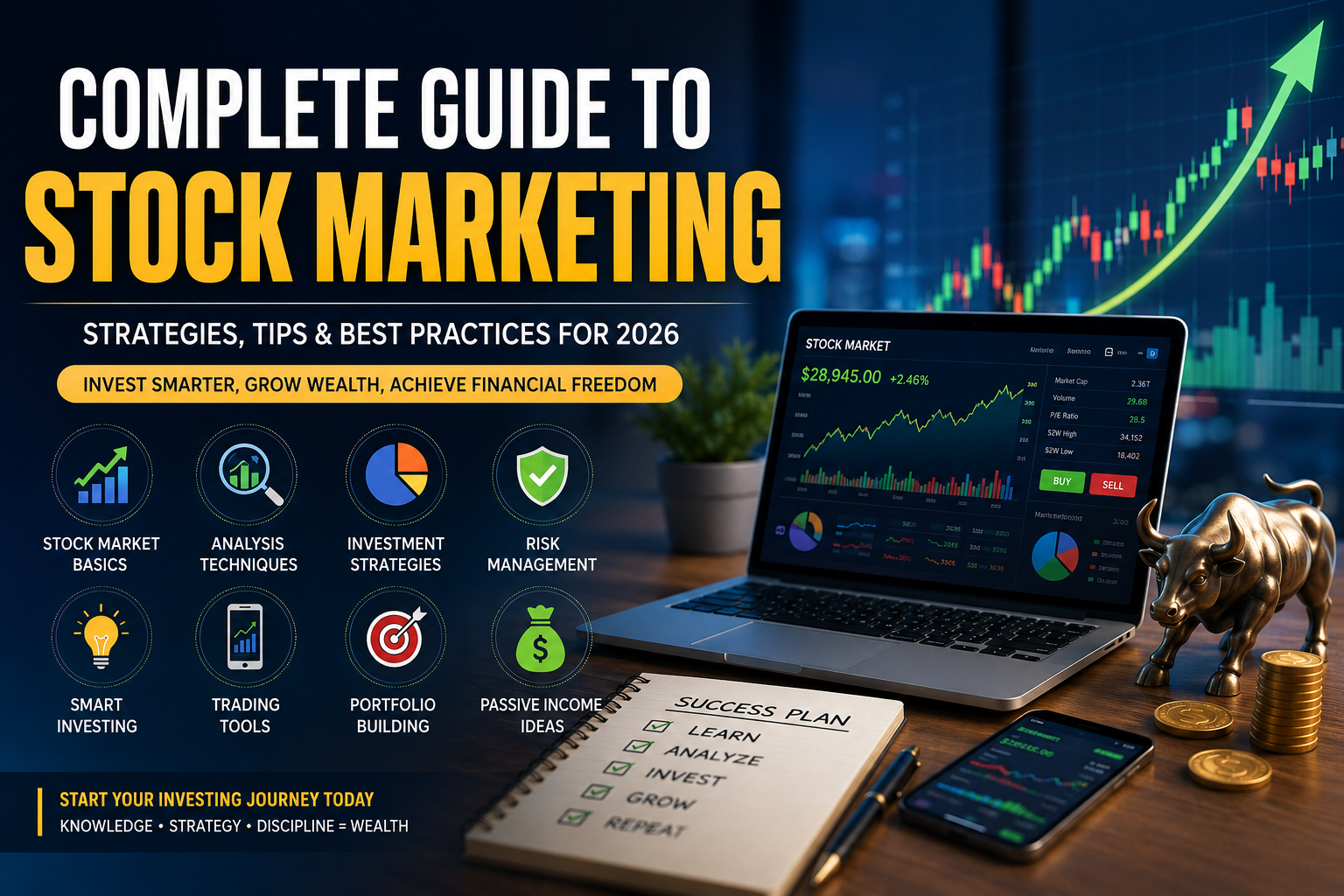
15 Powerful Stock Marketing Strategies That Can Skyrocket Your Investment Success in 2026

1. Introduction to Stock Marketing
1.1 What is Stock Marketing?
Stock marketing simply means buying, selling, and managing stocks to earn profits over time. In easy words, when you buy a stock, you are purchasing a small ownership share in a company. If that company grows, your investment can also grow.
For example, imagine investing in a strong company today. As the company expands and earns more profits, its stock price may increase. This helps investors earn money through stock price growth and sometimes through dividends as well.
A lot of beginners confuse stock marketing, stock trading, and share market investing. They sound similar, but there are slight differences.
- Stock marketing focuses on the overall process of investing and trading in stocks.
- Stock trading usually refers to short-term buying and selling.
- Share market investing often focuses on long-term wealth building.
No matter which term you use, the goal is usually the same — making smart financial decisions and growing your money.
Today, online stock trading has become easier than ever. You no longer need huge amounts of money to enter the equity market. With modern stock trading apps and beginner-friendly investment platforms, almost anyone can start learning about stock market investing from home.
Why Do People Invest in Stocks?
People invest in the stock market for different reasons. Some want passive income, while others want long-term financial security. Here are some common goals investors have:
- Building wealth slowly over time
- Earning passive income through dividend stocks
- Saving for retirement
- Achieving financial freedom
- Protecting money from inflation
Compared to keeping money in a regular savings account, long term investing in quality stocks can provide better returns over time. This is one reason why stock market investing continues to attract millions of new investors every year.
How Does the Stock Market Work?
The stock market works like a marketplace where buyers and sellers trade shares of companies. When demand for a company increases, its stock price usually rises. When investors lose confidence, prices can fall.
Stock exchanges help make this process organized and secure. Companies list their shares on stock exchanges so investors can buy and sell them easily.
The stock market is influenced by many things, including:
- Company performance
- Economic conditions
- Market news
- Investor emotions
- Global events
This is why stock market trends can change quickly sometimes. Smart investors focus on research instead of reacting emotionally to every market movement.
Stock Marketing for Beginners
If you are new to stock marketing, don’t worry. Every successful investor started as a beginner. The key is learning the basics first before risking large amounts of money.
A beginner stock market guide usually starts with understanding:
- How stocks work
- Basic stock market analysis
- Risk management in trading
- How to build an investment portfolio
- The difference between short-term and long-term investing
The good news is that you do not need to become a financial expert overnight. Even simple investing techniques can make a big difference if you stay consistent.
1.2 Why Stock Marketing is Important in 2026
Stock marketing is growing faster than ever in 2026. More people are learning about smart investing techniques because they want better financial opportunities and stronger income sources.
In the past, investing felt complicated. Today, technology has completely changed the game.
Rise of Online Stock Trading
One major reason behind the popularity of stock marketing is the growth of online stock trading platforms. Modern trading apps allow investors to buy stocks within minutes using their smartphones.
This convenience has made stock market investing more accessible for beginners. People can now:
- Track stock market trends live
- Study stock charts
- Use stock screening tools
- Manage investment portfolios easily
- Learn through online stock market education resources
As a result, more young investors are entering the share market than ever before.
People Want Financial Freedom
Another big reason stock marketing is becoming popular is the desire for financial freedom. Many people no longer want to rely only on one income source.
Investing in stocks can help create:
- Long-term wealth
- Passive income streams
- Retirement savings
- Financial security during inflation
Dividend investing has especially become popular among people looking for passive income stocks. These stocks pay regular dividends, helping investors earn money without selling their investments.
This is why many investors now search for terms like:
- best stock marketing strategies for beginners
- complete stock marketing guide for passive income
- safest stock market investments for beginners
The interest in these topics continues to grow because people want smarter ways to manage money in uncertain economic times.
Technology is Changing the Stock Market
Technology is also playing a massive role in modern stock marketing. Artificial intelligence, automation, and advanced stock trading indicators are helping investors make faster and smarter decisions.
Today’s investors can use:
- AI-powered stock research tools
- Automated trading systems
- Mobile stock trading apps
- Real-time market alerts
- Technical analysis software
Even beginners can now access professional-level tools that were once available only to large financial institutions.
More Beginners Are Learning Investing
Another important trend in 2026 is the rise of beginner investors. Social media, YouTube channels, blogs, and online financial communities have made stock market learning much easier.
People now search online for topics like:
- how to start stock market investing with little money
- easy stock market guide for new investors
- beginner friendly stock trading tips
This shows that interest in stock investing is no longer limited to financial experts. Everyday people are now learning how to analyze stocks, build portfolios, and grow their money step by step.
The Importance of Smart Investing
While stock marketing offers huge opportunities, smart investing is extremely important. Many beginners lose money because they chase hype, ignore research, or invest emotionally.
Successful investors usually focus on:
- Long-term investing
- Proper stock market research
- Diversification
- Risk management
- Patience and consistency
The stock market will always have ups and downs. But investors who stay informed and disciplined often perform much better over time.
Understanding stock marketing properly in 2026 is no longer optional for people who want strong financial growth. It has become one of the most practical ways to build wealth, create passive income, and prepare for the future.
3. How Beginners Can Start Stock Market Investing
3.1 Step-by-Step Beginner Guide
Starting in the stock market can feel confusing at first. There are thousands of stocks, endless advice online, and constant market updates. But once you break the process into simple steps, stock marketing becomes much easier to understand.
Let’s go through the beginner process step by step.
3.1.1 Set Your Investment Goals
Before investing even one dollar, you need to know why you are investing.
This is one of the most ignored steps in stock market investing, yet it’s one of the most important.
Ask yourself questions like:
- Do you want passive income?
- Are you saving for retirement?
- Do you want short-term profits or long-term wealth?
- How much risk can you handle?
Your goals will shape your stock investment strategies.
For example:
- Long-term investors usually focus on blue chip stocks and growth stocks.
- Short-term traders may focus more on day trading strategies or swing trading stocks.
- Passive income investors often prefer dividend investing.
Having clear goals also helps you stay calm during stock market volatility. Investors who jump into the market without a plan often panic when prices move up and down.
Short-Term vs Long-Term Investing
Short-term investing focuses on making profits quickly through stock price movements. This strategy can be exciting, but it usually carries more risk.
Long term investing focuses on holding quality stocks for years. Many experienced investors prefer this method because it reduces stress and allows investments to grow gradually over time.
For beginners, long-term investing is often the safer and smarter option.
3.1.2 Choose the Right Stock Broker
Your stock broker is the platform you use to buy and sell stocks. Choosing the right broker can make your investing journey much easier.
Today, many stock broker platforms offer beginner-friendly tools and low trading fees.
When comparing online stock trading platforms, look for:
- Easy-to-use interface
- Low transaction costs
- Fast customer support
- Educational resources
- Mobile trading apps
- Research and stock screening tools
Good stock trading apps also provide market insights, portfolio tracking, and real-time stock market news.
Beginners should avoid complicated platforms that are designed only for professional traders.
Why Trading Apps Matter in 2026
Modern trading apps have completely changed stock market education. Investors can now:
- Monitor investments anytime
- Analyze stock charts instantly
- Learn technical analysis basics
- Receive stock price alerts
- Research companies easily
This convenience has made stock market investing accessible to almost everyone.
3.1.3 Open Your Trading Account
Once you choose a broker, the next step is opening your trading account.
The process is usually simple and takes only a short time.
Most platforms require:
- Identity verification
- Bank account details
- Basic personal information
- Initial deposit amount
After verification, you can start exploring the stock market and building your investment portfolio.
Start Small and Learn Slowly
One of the best beginner friendly stock trading tips is to start with small investments.
You do not need thousands of dollars to begin.
In fact, many successful investors started by investing small amounts while learning how the market works. Starting small helps reduce emotional pressure and lowers risk while you gain experience.
This is especially useful for people searching for:
- how to start stock market investing with little money
- easy stock market guide for new investors
- safest stock market investments for beginners
Remember, stock marketing is a long-term learning process. There’s no need to rush.
3.2 Common Mistakes New Investors Make
Almost every beginner makes mistakes in the stock market. The goal is not to avoid every mistake completely — it’s to learn from them quickly.
Understanding these common problems can help you become a smarter investor.
Investing Emotionally
Emotions are one of the biggest dangers in stock trading.
Many beginners buy stocks because of hype and sell them out of fear during market drops.
This emotional behavior often leads to losses.
Smart investors rely on stock market research, company fundamentals, and strategy instead of panic or excitement.
Good investing decisions should come from logic, not emotions.
Ignoring Research
Some beginners buy stocks simply because someone online recommended them.
That’s risky.
Before investing, always study:
- Company performance
- Revenue growth
- Industry trends
- Financial reports
- Market competition
Basic stock market analysis can help you avoid poor-quality investments.
Learning fundamental analysis investing techniques is extremely valuable for long-term success.
Lack of Diversification
Putting all your money into one stock is dangerous.
If that company struggles, your entire investment can suffer.
Diversification helps reduce risk by spreading investments across different sectors and companies.
A balanced investment portfolio may include:
- Growth stocks
- Dividend stocks
- Blue chip companies
- Technology stocks
- Healthcare stocks
Diversification is one of the smartest investing techniques beginners can learn.
Panic Selling During Market Crashes
Stock market crashes are normal.
Every investor experiences market downturns at some point.
However, beginners often panic and sell their investments at the worst possible time.
Experienced investors understand that market declines are temporary. Instead of reacting emotionally, they focus on long-term investing goals.
Patience is one of the most valuable skills in stock marketing.
4. Best Stock Marketing Strategies That Actually Work
Many people search for shortcuts in the stock market, but successful investing usually comes down to proven strategies, discipline, and consistency.
The good news is that you don’t need complicated systems to become a better investor. Even simple stock investment strategies can produce strong results when used correctly.
Let’s look at some of the best stock marketing strategies that continue to work in 2026.
4.1 Long-Term Investing Strategy
Long-term investing is one of the safest and most effective ways to build wealth through the stock market.
This strategy focuses on buying strong companies and holding them for years instead of constantly buying and selling.
Why Long-Term Investing Works
The stock market naturally moves up and down in the short term. But historically, quality companies tend to grow over time.
Long-term investors benefit from:
- Compound growth
- Dividend income
- Lower trading stress
- Reduced emotional decisions
- Better stock market returns
Instead of chasing quick profits, long-term investors focus on business growth and future potential.
This is why many financial experts recommend long term investing for beginners.
Buy and Hold Strategy
The buy and hold strategy is simple:
- Research strong companies
- Buy shares at reasonable prices
- Hold investments patiently over time
This strategy works especially well with blue chip stocks and companies with strong financial performance.
Investors who constantly jump between stocks often struggle because they react emotionally to every market trend.
Patience is usually rewarded in the stock market.
4.2 Day Trading vs Swing Trading
Some investors prefer short-term trading strategies instead of long-term investing.
Two popular methods are day trading and swing trading.
Although both aim to profit from short-term stock movements, they work differently.
4.2.1 What is Day Trading?
1 Day trading involves buying and selling stocks within the same day.
Day traders try to profit from small price movements using technical analysis stocks and stock trading indicators.

Day Trading Requires:
- Fast decision-making
- Constant market monitoring
- Strong technical analysis skills
- Risk management discipline
While day trading can be profitable, it also carries high risk.
Beginners often underestimate how stressful and difficult short-term trading can be.
4.2.2 What is Swing Trading?
Swing trading focuses on holding stocks for several days or weeks.
Swing traders try to capture medium-term price movements instead of minute-by-minute changes.
This method is often less stressful than day trading and better suited for part-time investors.
Swing traders commonly use:
- Candlestick chart patterns
- Technical analysis
- Support and resistance levels
- Market trend analysis
Swing trading stocks can provide good opportunities, but risk management still remains very important.
4.3 Value Investing Strategy
Value investing focuses on finding stocks that appear undervalued compared to their actual worth.
In simple words, value investors look for good companies selling at lower prices.
How Value Investing Works
Value investors analyze:
- Company earnings
- Revenue growth
- Financial strength
- Future business potential
- Market position
The goal is to buy quality companies before the market fully recognizes their value.
This strategy became famous because of legendary investors like Warren Buffett.
Why Value Investing is Popular
Value investing remains one of the most respected stock investment strategies because it focuses on logic instead of hype.
It encourages investors to:
- Think long term
- Avoid emotional trading
- Study businesses carefully
- Invest based on research
This method may require patience, but it can produce strong long-term results.
For beginners learning stock marketing, value investing offers a smart foundation for understanding how successful investors analyze companies and make investment decisions.
5. How to Analyze Stocks Like a Pro
5.1 Fundamental Analysis Explained
One of the biggest differences between successful investors and beginners is research. Professional investors rarely buy stocks randomly. They study companies carefully before investing money.
This process is called fundamental analysis investing.
Fundamental analysis helps investors understand whether a company is financially strong or weak. Instead of focusing only on stock price movements, this method looks at the actual business behind the stock.
What Investors Check During Fundamental Analysis
When analyzing a company, investors usually study:
- Revenue growth
- Company profits
- Debt levels
- Future business plans
- Industry competition
- Market position
These factors help investors decide whether a company has long-term growth potential.
For example, if a company continues increasing its revenue every year, many investors see that as a positive sign.
Understanding Revenue and Profit
Revenue is the total money a company earns from its products or services.
Profit is the money left after expenses are deducted.
A company may have high revenue, but if profits are weak, that could indicate problems in the business model.
This is why smart investors study both numbers carefully during stock market research.
What is the P/E Ratio?
The P/E ratio, or Price-to-Earnings ratio, is one of the most popular stock market analysis tools.
It compares a company’s stock price to its earnings.
In simple words:
- A very high P/E ratio may suggest the stock is expensive
- A lower P/E ratio may suggest better value
However, investors should never rely on one number alone. A strong stock investment guide always includes multiple factors before making decisions.
Why Fundamental Analysis Matters
Fundamental analysis helps investors:
- Avoid poor-quality companies
- Identify growth opportunities
- Make smarter long-term investing decisions
- Reduce emotional investing mistakes
Investors searching for the best stocks to invest in for long term growth often rely heavily on this method.
5.2 Technical Analysis for Beginners
While fundamental analysis focuses on companies, technical analysis focuses on stock price movements and market behavior.
Technical analysis stocks are studied using charts, patterns, and indicators.
This method is especially popular among:
- Day traders
- Swing traders
- Short-term investors
The goal is to identify possible future price movements based on historical market data.
5.2.1 Reading Stock Charts
Stock charts may look confusing at first, but learning basic chart reading can greatly improve your stock trading skills.
Charts help investors understand:
- Price trends
- Market momentum
- Buying pressure
- Selling pressure
One of the most popular chart styles is the candlestick chart.
Candlestick Chart Patterns
Candlestick chart patterns visually show stock price movement during specific time periods.
Each candlestick provides information about:
- Opening price
- Closing price
- Highest price
- Lowest price
Over time, certain chart patterns can indicate bullish stock trends or bearish market trends.
Some common patterns include:
- Hammer pattern
- Doji pattern
- Engulfing candles
- Morning star pattern
Learning these patterns can help traders make more informed decisions.
5.2.2 Popular Trading Indicators
Technical traders also use stock trading indicators to analyze market behavior.
These indicators help investors identify possible buying or selling opportunities.
RSI (Relative Strength Index)
RSI measures whether a stock is overbought or oversold.
- High RSI may indicate overbuying
- Low RSI may indicate overselling
Many swing trading stocks are analyzed using RSI signals.
MACD Indicator
MACD stands for Moving Average Convergence Divergence.
This indicator helps traders identify trend changes and momentum shifts.
Many experienced traders combine MACD with other technical analysis stocks strategies to improve accuracy.
Moving Averages
Moving averages help smooth price data and identify overall market direction.
Two common types include:
- 50-day moving average
- 200-day moving average
When short-term averages cross above long-term averages, investors often see this as a bullish signal.
Technical analysis becomes more useful when combined with proper stock market research and risk management.
6. Risk Management in Stock Marketing
Many beginners focus only on profits, but experienced investors focus heavily on protecting their money.
This is where risk management in trading becomes extremely important.
Even the best investors sometimes lose money. The goal is not to avoid losses completely — it’s to keep losses small and manageable.
6.1 Why Risk Management Matters
Without proper risk management, one bad investment can damage your entire portfolio.
The stock market is unpredictable. Prices can rise quickly, but they can also fall suddenly due to:
- Economic problems
- Company scandals
- Global events
- Market crashes
- Investor fear
This is why stock market volatility should never be ignored.
Protecting Your Investment Capital
Your investment capital is your biggest asset.
If you lose too much money early, it becomes much harder to recover.
Smart investors focus on preserving capital first and growing it second.
This mindset helps investors survive difficult market conditions.
Emotional Control is Important
Risk management also helps reduce emotional investing.
When investors risk too much money on one trade, fear and stress usually increase.
This often leads to poor decisions like:
- Panic selling
- Revenge trading
- Overtrading
- Buying based on hype
Good stock trading tips always include emotional discipline and patience.
6.2 Smart Ways to Reduce Risk
Successful stock market investing is not only about finding profitable stocks. It’s also about reducing unnecessary risks.
Here are some practical ways investors manage risk.
6.2.1 Diversify Your Portfolio
Diversification means spreading investments across different assets instead of relying on one company or sector.
This strategy reduces the impact of a single bad investment.
A balanced investment portfolio may include:
- Technology stocks
- Healthcare stocks
- Dividend stocks
- Growth companies
- Blue chip stocks
Diversification is one of the smartest stock investment strategies beginners can follow.
6.2.2 Invest for the Long Term
Short-term market movements can be stressful.
Long term investing helps reduce the pressure of daily stock market fluctuations.
Historically, long-term investors have often performed better because they avoid emotional reactions and allow investments time to grow.
This is one reason many financial experts recommend long-term stock market investing for beginners.
6.2.3 Use Stop Loss Orders
A stop loss order automatically sells a stock if its price drops to a certain level.
This tool helps investors limit losses during sudden market declines.
For example:
- If you buy a stock at $100
- You may set a stop loss at $90
- If the price falls to $90, the stock automatically sells
This strategy helps protect capital and reduce emotional decision-making.
7. Best Tools and Platforms for Stock Trading
Modern stock marketing is heavily powered by technology. Today’s investors have access to tools that make research, trading, and portfolio management easier than ever.
The right tools can save time, improve decisions, and help investors avoid beginner mistakes.
7.1 Top Features to Look for in Trading Platforms
Not all stock broker platforms are the same. Some are designed for beginners, while others are built for professional traders.
Choosing the right online stock trading platform can improve your entire investing experience.
User-Friendly Dashboard
Beginners should choose platforms with simple and easy navigation.
A clean dashboard makes it easier to:
- Track stocks
- Manage investments
- Analyze performance
- Place trades quickly
Complicated platforms often overwhelm new investors.
Research and Analysis Tools
Good stock trading apps offer built-in research tools such as:
- Stock screeners
- Financial reports
- Technical charts
- Market news updates
- Stock market trends analysis
These tools help investors make smarter decisions instead of relying on rumors.
Low Trading Fees
Trading costs can reduce profits over time.
This is why many investors compare:
- Commission fees
- Withdrawal charges
- Account maintenance costs
Low-cost brokers are especially helpful for beginners starting with small investments.
Mobile Trading Apps
In 2026, mobile investing is becoming more popular than desktop trading.
Modern stock trading apps allow investors to:
- Buy stocks instantly
- Monitor portfolio performance
- Set market alerts
- Read financial market insights
This flexibility makes investing more convenient for busy users.
7.2 Helpful Tools for Stock Research
Research plays a huge role in successful stock marketing.
Here are some useful tools investors commonly use.
Stock Screeners
Stock screening tools help investors filter stocks based on specific conditions.
For example, investors can search for:
- Low debt companies
- High dividend stocks
- Fast-growing companies
- Undervalued stocks
This saves time and improves research efficiency.
Portfolio Trackers
Portfolio trackers help investors monitor:
- Investment growth
- Profit and loss
- Asset allocation
- Portfolio performance
These tools help investors stay organized and make better financial decisions.
Financial News Platforms
Stock market news platforms provide updates about:
- Company earnings
- Economic trends
- Market crashes
- Industry developments
Staying informed helps investors react intelligently instead of emotionally.
Reliable information is extremely important in stock marketing.
8. How to Build a Profitable Stock Portfolio
Building a profitable investment portfolio is one of the most important goals in stock market investing.
A strong portfolio balances growth opportunities with risk management.
Successful portfolios are usually built slowly over time, not overnight.
8.1 Creating a Balanced Investment Portfolio
A balanced portfolio spreads investments across multiple categories to reduce risk and improve stability.
Instead of chasing one “perfect stock,” smart investors build a mix of different investments.
Combining Different Types of Stocks
Many investors include a combination of:
- Growth stocks
- Dividend stocks
- Blue chip companies
- Technology stocks
- Defensive stocks
This approach helps reduce risk during market volatility.
Balancing Risk and Reward
Higher-risk stocks may offer bigger rewards, but they can also produce larger losses.
Safer investments may grow slower but provide more stability.
The key is finding a balance that matches your financial goals and risk tolerance.
This is why proper stock portfolio management matters so much.
8.2 Best Sectors to Watch in 2026
Some industries are expected to grow rapidly in the coming years.
Investors searching for the best stock marketing strategies for beginners often focus on strong future-growth sectors.
Technology Stocks
Technology continues leading global market growth.
Companies involved in:
- Artificial intelligence
- Cloud computing
- Cybersecurity
- Software development
are attracting massive investor interest.
AI Companies
Artificial intelligence is transforming multiple industries.
Many investors believe AI-focused companies may offer strong long-term growth opportunities in 2026 and beyond.
This sector has become one of the hottest areas for stock market investing.
Renewable Energy Stocks
Renewable energy is growing as countries focus on cleaner energy solutions.
Investors are closely watching companies involved in:
- Solar energy
- Electric vehicles
- Battery technology
- Wind energy
This sector may continue expanding over the next decade.
Healthcare Stocks
Healthcare remains one of the most stable sectors in the stock market.
Medical technology, biotechnology, and pharmaceutical companies continue attracting long-term investors due to consistent global demand.
For investors searching for the best stocks to invest in for long term growth, healthcare often remains a strong option.
9. Stock Market Trends and Predictions for 2026
The stock market is evolving rapidly. Technology, artificial intelligence, and changing investor habits are creating new opportunities in stock marketing.
Understanding current stock market trends can help investors make better decisions and prepare for future opportunities.
9.1 Current Market Trends Investors Should Know
Several major trends are shaping stock market investing in 2026. Investors who stay informed about these trends may identify profitable opportunities earlier than others.
AI is Transforming the Investment World
Artificial intelligence is becoming one of the biggest forces in the stock market.
AI tools are now helping investors:
- Analyze stocks faster
- Track stock market trends
- Identify trading opportunities
- Improve portfolio management
- Predict market behavior
Many stock broker platforms now offer AI-powered stock screening tools and automated research systems.
AI-related companies are also attracting huge attention from investors looking for long-term growth opportunities.
This is why many experts believe AI stocks may remain among the best stocks to invest in for long term growth.
Retail Investors Continue to Grow
Another major trend is the rise of retail investors.
In the past, stock market investing was mostly dominated by financial institutions and professional traders. Today, regular people are entering the share market in massive numbers.
Several factors are driving this growth:
- Easy-to-use stock trading apps
- Free stock market education online
- Social media financial content
- Low-cost online stock trading platforms
This increase in beginner investors is changing the way markets move.
Retail investors now have more influence on stock price movements than ever before.
Mobile Investing is Becoming the New Standard
Modern investors want speed and convenience.
This is why mobile stock trading apps continue growing rapidly in popularity.
People now use smartphones to:
- Buy and sell stocks instantly
- Read financial market insights
- Track investment portfolio performance
- Monitor stock market news
- Receive real-time alerts
This trend is expected to continue throughout 2026 and beyond.
Increased Market Volatility
Stock market volatility remains an important trend investors should understand.
Economic uncertainty, global conflicts, inflation concerns, and interest rate changes can all create sudden market swings.
This is why risk management in trading is becoming more important than ever.
Investors who remain calm during volatile periods often perform better than those who panic and make emotional decisions.
9.2 Future of Stock Marketing
The future of stock marketing will likely become more technology-driven, data-focused, and accessible to everyday investors.
Let’s look at some expected future developments.
Automation in Trading
Automated investing systems are becoming increasingly popular.
These systems can:
- Execute trades automatically
- Analyze market data quickly
- Reduce emotional investing decisions
- Improve trading efficiency
While automation can be useful, investors still need proper stock market research and strategy.
Technology should support decision-making, not completely replace human judgment.
AI-Powered Investment Tools
AI-powered investment tools are expected to become even more advanced in the coming years.
Future tools may help investors:
- Predict market patterns
- Detect risk earlier
- Improve stock market analysis
- Personalize investment strategies
This could make stock marketing more beginner-friendly and efficient.
However, investors should still understand the basics of investing instead of relying only on software predictions.
Growing Interest in Financial Freedom
More people are becoming interested in financial independence and passive income investing.
As living costs continue rising, investors are searching for smarter ways to grow wealth.
This trend is increasing interest in:
- Dividend investing
- Long term investing
- Passive income stocks
- Smart investing techniques
- Stock market opportunities
The desire for financial freedom investing is likely to remain strong throughout 2026.
10. Frequently Asked Questions About Stock Marketing
Beginners often have many questions before entering the stock market. Understanding these basics can help investors feel more confident and avoid common mistakes.
10.1 Is Stock Marketing Safe for Beginners?
Stock marketing always carries some level of risk, but it can be much safer when approached correctly.
Beginners who focus on:
- Long-term investing
- Diversification
- Stock market education
- Risk management
usually perform better than people chasing quick profits.
Starting with small investments and learning slowly is often the safest approach.
10.2 How Much Money Do You Need to Start Investing?
One of the biggest myths about stock market investing is that you need a lot of money to begin.
In reality, many online stock trading platforms allow beginners to start with small amounts.
Some investors even begin with limited budgets while learning basic stock investment strategies.
The important thing is consistency, not starting with huge capital.
This is why many beginners search for:
- how to start stock market investing with little money
- easy stock market guide for new investors
10.3 Can You Earn Passive Income from Stocks?
Yes, passive income is one of the biggest benefits of stock investing.
Dividend investing allows investors to earn regular income from certain companies that share profits with shareholders.
Many investors build portfolios focused on:
- Dividend stocks
- Blue chip companies
- Stable long-term businesses
This strategy can help generate passive income over time.
10.4 Which Stocks are Best for Beginners?
Beginners often prefer stocks with:
- Strong financial performance
- Stable growth
- Reliable management
- Lower volatility
Blue chip stocks and established companies are usually considered safer options for new investors.
Beginners should avoid investing blindly in highly risky or heavily hyped stocks without proper stock market research.
10.5 Is Long-Term Investing Better Than Trading?
For most beginners, long-term investing is usually the better option.
Long-term investing generally involves:
- Less stress
- Lower trading costs
- Reduced emotional pressure
- Better compound growth opportunities
Short-term stock trading can be profitable, but it often requires advanced technical analysis skills, experience, and emotional discipline.
This is why many experts recommend long term investing for beginners entering the stock market.
11. Final Conclusion
Stock marketing is no longer limited to financial experts or wealthy investors. In 2026, almost anyone can start learning how the stock market works and begin building wealth step by step.
The key to success is not finding “secret stocks” or becoming rich overnight. Real success in stock market investing comes from:
- Continuous learning
- Smart stock investment strategies
- Proper risk management
- Patience and discipline
- Long-term thinking
Investors who focus on stock market education and avoid emotional decisions usually place themselves in a much stronger position over time.
Whether your goal is:
- Building passive income
- Achieving financial freedom
- Growing long-term wealth
- Creating retirement savings
the stock market can provide powerful opportunities when approached correctly.
Remember, every successful investor started as a beginner. The most important step is simply getting started, staying consistent, and continuing to improve your understanding of the market.
As stock marketing continues evolving with AI, automation, and modern trading technology, investors who stay informed and adaptable may discover even greater opportunities in the future.