

Blockchain Explained in the Simplest Way
A lot of people think blockchain is only about Bitcoin or cryptocurrency. That’s the biggest myth out there.
The truth is, blockchain technology is much bigger than digital coins. Yes, Bitcoin made blockchain famous, but blockchain is actually a powerful system that can change how information is stored, shared, and protected across the world.
If you’ve ever searched for “blockchain explained for beginners” or wondered “what is blockchain and how does it work?” you’re not alone. It sounds technical, confusing, and honestly a little intimidating at first.
But here’s the good news.
Once someone explains blockchain in simple words, it becomes surprisingly easy to understand.
simple guide to blockchain technology
Think of this as your simple guide to blockchain technology — no confusing technical jargon, no complicated coding talk, and definitely no boring textbook-style explanation.
By the end of this guide, you’ll clearly understand:
- What blockchain actually is
- Why people call it revolutionary
- How blockchain works behind the scenes
- Why industries beyond crypto are using it
- Why blockchain matters for the future
Let’s break it down.
Blockchain explained simply means understanding a system that stores information in a secure digital way without needing one central authority to control it.
That sounds fancy, but imagine this:
Picture a giant digital notebook shared across thousands of computers around the world.
Every time new information gets added, everyone gets an updated copy. Nobody can secretly change old records. Everyone can verify the information is correct.
That shared notebook is basically what a digital ledger is.
And that digital ledger is the foundation of blockchain technology.
This is why blockchain has become one of the most talked-about innovations in finance, healthcare, online security, supply chains, and even gaming.
People often call blockchain the future because it solves real-world problems like:
- Fraud and data tampering
- Slow international payments
- Lack of transparency
- High transaction fees
- Security risks in centralized systems
In simple terms, blockchain creates trust without needing a middleman.
And in today’s digital world, trust is everything.
That’s why learning blockchain basics is becoming important for students, investors, developers, and everyday internet users.
The idea may sound futuristic, but blockchain is already here.
Banks use it.
Hospitals are exploring it.
Businesses are investing billions into it.
Governments are studying it.
And chances are, blockchain will become part of your life sooner than you think.
So before we go deeper into how blockchain works step by step, let’s answer the most important question first.
What Is Blockchain? (Simple Beginner Explanation)
So, what is blockchain exactly?
At its core, blockchain is a distributed ledger technology that records information securely across multiple computers.
That might sound technical, but let’s simplify it.
Imagine you and 1,000 other people share the same Google Sheet.
Every time someone adds new information, everyone sees it instantly.
Nobody can secretly edit old entries without everyone noticing.
And every update gets verified before it becomes permanent.
That’s basically how blockchain works.
Instead of storing information in one central place like a bank server, blockchain stores copies of the same information across many computers in a decentralized network.
This means no single company, bank, or person controls the data.
That’s why blockchain is called decentralized.
It removes the need for a middleman.
This is one of the biggest reasons blockchain technology explained simply often sounds revolutionary.
Because for centuries, we’ve trusted central authorities to manage information.
Banks store your money records.
Social media platforms store your data.
Governments store legal documents.
Blockchain changes that model completely.
Instead of trusting one authority, trust is spread across the entire network.
That makes blockchain more transparent and often more secure.
Breaking Blockchain Into Two Simple Words
The word “blockchain” has two parts:
Block → A collection of digital information
Chain → A secure link connecting one block to another
Every block stores data.
This data could be:
- Cryptocurrency transactions
- Smart contracts
- Medical records
- Supply chain information
- Ownership records
Once a block fills up with data, it gets connected to the previous block.
That creates a chain of blocks.
Hence the name: blockchain.
This chain keeps growing as new information gets added.
And here’s the important part:
Once information enters the blockchain, changing it becomes extremely difficult.
That’s because every computer in the blockchain network has to agree to the change.
This process is called validation.
That’s where blockchain verification and blockchain security come in.
Why Blockchain Is Called a Digital Ledger
A ledger is simply a record book.
Traditional banks use ledgers to record who sent money, who received it, and when it happened.
Blockchain does the same thing — but digitally and publicly across a peer-to-peer network.
That’s why blockchain is often called a digital ledger system.
The difference is this:
Traditional ledgers are controlled by one organization.
Blockchain ledgers are shared and verified by thousands of participants.
That’s what makes blockchain unique.
It creates trust through technology instead of relying on institutions.
A Real-Life Example of Blockchain Explained
Let’s say Ahmed sends money to Ali using blockchain.
Here’s what happens:
First, Ahmed requests the transaction.
The blockchain network checks if Ahmed has enough funds.
Then multiple computers (called nodes) verify the request.
Once verified, the transaction is added to a new block.
That block gets connected to the previous blockchain record.
Now the transaction becomes permanent and visible to the network.
1.No bank approval needed.
2.No middleman fees.
3.No delays caused by office hours.
This is one reason why cryptocurrency blockchain systems became popular.
They allow direct transfers between people anywhere in the world.
Fast, secure, and transparent.
Why Blockchain Matters Today
Understanding blockchain is no longer optional if you want to keep up with technology.
Why?
Because blockchain applications are growing fast.
Today, blockchain is used for:
- Cryptocurrency payments
- Smart contracts
- Digital identity systems
- Healthcare record security
- Supply chain tracking
- Voting systems
- NFT ownership verification
This is why people call blockchain the next internet revolution.
And honestly, they might be right.
The internet changed how we share information.
Blockchain may change how we store and trust information.
That’s the real power behind understanding blockchain.
It’s not just about coins or trading.
It’s about building systems that are transparent, secure, and efficient for everyone.
And now that you know what blockchain is, the next step is learning exactly how blockchain works step by step.
Blockchain Explained Step by Step
Many people believe blockchain works like magic and only computer experts can understand it.
That’s not true at all.
In reality, once you see how blockchain works step by step, the whole system becomes much easier to understand. The process is actually built around a few simple actions: recording information, verifying it, and storing it securely.
The complicated words often scare beginners away, but the core idea behind blockchain technology is surprisingly simple.
Let’s break it down in the easiest way possible.
Step 1: A Transaction Starts
Everything in blockchain begins with a transaction.
Now, when people hear the word “transaction,” they usually think about cryptocurrency payments like Bitcoin or Ethereum. But blockchain transactions can involve much more than money.
A transaction can include:
- Sending cryptocurrency
- Sharing medical records
- Verifying ownership
- Signing smart contracts
- Tracking products in a supply chain
For example, imagine Sara wants to send Bitcoin to Ahmed.
She enters Ahmed’s wallet address and clicks send.
That action creates a transaction request inside the blockchain network.
This is the starting point of the blockchain system.
Step 2: The Transaction Gets Verified
Here’s where blockchain becomes interesting.
Unlike traditional banking systems, there’s no central authority checking the transaction.
Instead, blockchain uses a peer-to-peer network made up of computers called nodes.
These nodes work together to verify whether the transaction is valid.
They check things like:
- Does Sara actually own the Bitcoin?
- Does she have enough balance?
- Is the transaction legitimate?
This process is called blockchain validation.
The nodes follow specific blockchain rules known as a blockchain protocol to confirm the transaction.
Once enough nodes agree the transaction is valid, it moves forward.
This decentralized verification process is one reason why blockchain technology explained simply is considered more transparent than traditional systems.
No single company controls the approval process.
The network itself does the work.
Step 3: The Data Gets Added Into a Block
After verification, the transaction joins other verified transactions.
These transactions get grouped together into a “block.”
Think of a block like a digital storage container holding records.
Each block contains important details such as:
- Transaction information
- Time and date
- Digital signatures
- Unique identifying codes
Every block also gets a special code called a hash.
This hash acts like a digital fingerprint.
Even the smallest change inside the block creates a completely different hash.
That’s a major reason blockchain security is so strong.
If someone tries to alter the information, the entire network immediately notices the mismatch.
This is what makes blockchain data storage highly secure and trustworthy.
Step 4: The Block Connects to Previous Blocks
Once the new block is complete, it links to the previous block.
This creates a secure chain of connected blocks.
That’s literally where the term blockchain comes from.
Every new block contains information connected to the block before it.
So instead of isolated records, blockchain creates a continuous history of verified data.
This structure makes blockchain extremely difficult to tamper with.
Why?
Because changing one block would require changing every connected block after it across thousands of computers at the same time.
And that’s practically impossible in large blockchain networks.
This connected structure is one of the biggest strengths of distributed ledger technology.
It creates transparency, trust, and permanent record keeping.
Step 5: The Transaction Becomes Permanent
After the block gets added to the blockchain, the transaction becomes permanent.
This feature is called immutability.
In simple words, it means the information cannot easily be changed or deleted.
That’s important because permanent records help reduce:
- Fraud
- Fake transactions
- Data manipulation
- Unauthorized edits
This is why industries beyond cryptocurrency are becoming interested in blockchain applications.
Businesses want secure systems where records stay accurate and trustworthy.
For example:
- Hospitals can protect patient records
- Supply chains can track products safely
- Banks can reduce fraud risks
- Governments can improve transparency
Once data enters the blockchain network, everyone in the system can trust the record.
That’s one reason blockchain innovation is growing rapidly worldwide.

Why This Process Makes Blockchain So Powerful
When people search for “blockchain explained with real life examples”, they usually want to know why blockchain matters.
The answer is simple.
Blockchain removes the need to blindly trust one central authority.
Instead, the system creates trust through technology, verification, and transparency.
Here’s what makes blockchain unique:
- Transactions get verified by multiple computers
- Records stay transparent
- Data becomes difficult to alter
- The system works without middlemen
- Information stays secure through encryption
That combination creates a more reliable digital environment.
And that’s exactly why blockchain is changing industries far beyond cryptocurrency.
Key Features of Blockchain Technology
One common misconception is that blockchain is only valuable because of cryptocurrency.
But honestly, cryptocurrency is just one small piece of the puzzle.
The real power of blockchain comes from its features.
These features solve problems that traditional systems have struggled with for years.
That’s why companies, banks, developers, and even governments are investing heavily in blockchain technology.
Let’s look at the key features that make blockchain different from traditional systems.
Decentralization — No Single Authority Controls It
Traditional systems usually rely on one central authority.
For example:
- Banks control financial records
- Social media companies control user data
- Governments manage official databases
Blockchain works differently.
Instead of storing information in one location, blockchain spreads data across a decentralized network of computers.
This means no single person or organization has full control.
Every participant in the network helps maintain the system.
This decentralized approach improves:
- Security
- Transparency
- Reliability
- Fairness
It also reduces the risk of system failures.
If one computer goes offline, the blockchain network still continues running.
That’s a huge advantage over centralized systems.
Transparency — Everyone Can Verify Information
Transparency is another major reason blockchain matters.
In many blockchain networks, transactions are visible to participants.
This doesn’t mean personal identities become public.
It simply means transaction activity can be verified openly.
For example, users can track:
- When transactions happen
- How much was transferred
- Whether the transaction was completed
This level of visibility improves trust.
Traditional systems often hide information behind private databases.
Blockchain creates a more open environment.
That’s why blockchain transparency is considered one of its strongest features.
Businesses especially value this in industries like supply chain management and finance.
Security — Blockchain Uses Strong Protection
Security is one of the biggest reasons blockchain technology became popular so quickly.
Blockchain protects data using advanced cryptography and encryption methods.
Every transaction gets secured with digital signatures and hashes.
This makes unauthorized changes extremely difficult.
Unlike centralized databases, blockchain doesn’t have one single weak point hackers can easily attack.
Instead, information exists across multiple nodes in the network.
This structure strengthens blockchain network security significantly.
Even if someone attempts to change a record, the entire network can detect the inconsistency.
That’s why blockchain is widely considered one of the safest ways to store digital records.
Immutability — Records Cannot Easily Be Changed
One of blockchain’s most powerful features is immutability.
Once information gets recorded inside the blockchain, changing it becomes extremely difficult.
This creates permanent and trustworthy records.
Traditional systems allow administrators to edit or delete data more easily.
Blockchain reduces that risk.
This feature is especially useful for:
- Financial transactions
- Legal documents
- Healthcare records
- Ownership verification
Businesses value immutable records because they improve accountability and reduce fraud risks.
That’s why blockchain explained simply often focuses heavily on trust and transparency.
Speed and Efficiency — Faster Than Many Traditional Systems
Traditional financial systems can sometimes take days to process transactions.
Especially international payments.
Blockchain can often complete transactions much faster because it removes intermediaries.
There’s no need for multiple approvals between banks or institutions.
This can improve transaction speed and lower operational costs.
Blockchain also helps automate processes using smart contracts.
Smart contracts are digital agreements that automatically execute when conditions are met.
This reduces paperwork, delays, and human error.
That’s one reason decentralized finance and blockchain innovation are growing rapidly around the world.
Why These Features Matter for the Future
The reason blockchain continues gaining attention is simple.
Its features solve real-world problems.
People want systems that are:
- Secure
- Transparent
- Fast
- Reliable
- Decentralized
Blockchain combines all of these into one technology.
That’s why industries from banking to healthcare are exploring blockchain solutions.
And honestly, we’re still in the early stages.
As blockchain development continues improving, we’ll likely see even more real-world use cases emerge in the future.
The technology may still feel new to many people, but its impact is already becoming impossible to ignore.
Types of Blockchain Explained
A lot of beginners think there is only one type of blockchain.
That’s not true.
Not every blockchain works the same way. Different industries and companies use different blockchain systems depending on their needs. Some blockchains are fully public, while others are private and controlled.
Understanding these blockchain types is important because it helps you see how flexible blockchain technology really is.
Let’s break them down in simple words.
Public Blockchain — Open for Everyone
A public blockchain is completely open.
Anyone can join the network, verify transactions, and view records.
This is the most popular type of blockchain because it powers cryptocurrencies like Bitcoin and Ethereum.
The best thing about public blockchains is transparency.
No central authority controls the system.
Instead, the blockchain network operates through decentralization and community participation.
Examples of public blockchain systems include:
- Bitcoin blockchain
- Ethereum blockchain
- Litecoin
- Solana
These networks use distributed ledger technology to keep records secure and transparent.
Main Features of Public Blockchain
- Open access for everyone
- High transparency
- Strong blockchain security
- Fully decentralized
- Community-driven verification
Downsides of Public Blockchain
Because public blockchains are open to everyone, they sometimes face:
- Slower transaction speeds
- Scalability challenges
- Higher energy usage
Still, public blockchain systems remain the foundation of cryptocurrency blockchain technology today.
Private Blockchain — Controlled Access
A private blockchain works differently.
Instead of allowing everyone to join, access is limited to approved users only.
Companies and organizations often use private blockchains to protect sensitive data and improve efficiency.
For example, a hospital may use a private blockchain to manage medical records securely.
A business may use one for supply chain management.
In private blockchain systems:
- One organization controls permissions
- Access stays restricted
- Transactions are faster
- Data privacy improves
This type of blockchain is popular in enterprise environments where companies need better control over their blockchain ecosystem.
Main Features of Private Blockchain
- Restricted access
- Faster performance
- Better privacy
- Lower energy usage
- Controlled participation
Private blockchains may not be fully decentralized, but they are practical for many real-world blockchain applications.
Consortium Blockchain — Shared Control Between Organizations
A consortium blockchain is a mix between public and private blockchain systems.
Instead of one company controlling the network, multiple organizations share control together.
This model works well for industries where several companies need shared access to trusted data.
Examples include:
- Banking groups
- Healthcare networks
- Supply chain partnerships
Imagine several banks sharing one blockchain system for faster financial transactions.
No single bank fully controls the network.
Instead, decision-making gets shared among trusted participants.
This improves transparency while still maintaining some privacy.
That’s why consortium blockchains are becoming more common in enterprise blockchain development.
Hybrid Blockchain — Combining the Best of Both Worlds
A hybrid blockchain combines features from both public and private blockchain systems.
Some information stays public, while sensitive data remains private.
This gives organizations more flexibility.
For example:
A company may want customers to verify product authenticity publicly while keeping internal business records private.
Hybrid blockchain systems make that possible.
Benefits of Hybrid Blockchain
- Better flexibility
- Improved privacy control
- Increased transparency when needed
- Faster operations
- More business customization
This model is becoming increasingly popular as blockchain innovation grows across industries.
Why Understanding Blockchain Types Matters
When people search for “blockchain technology explained for beginners,” they often assume blockchain is one single universal system.
But blockchain technology is actually very adaptable.
Different blockchain structures solve different problems.
Some focus on transparency.
Others focus on privacy.
Some prioritize speed.
Others prioritize decentralization.
That flexibility is one reason blockchain continues expanding into industries far beyond cryptocurrency.
Blockchain vs Traditional Banking Systems
One of the biggest myths about blockchain is that it simply wants to “replace banks.”
That’s not entirely true.
Blockchain technology and traditional banking systems actually solve some similar problems — but they do it in very different ways.
Understanding this comparison helps explain why blockchain has gained so much global attention.
Let’s compare them side by side.
Centralized vs Decentralized Systems
Traditional banks operate through centralized control.
That means one institution manages:
- Accounts
- Transactions
- Security
- Approvals
- Financial records
Customers trust the bank to manage everything properly.
Blockchain works differently.
Blockchain uses a decentralized network where records are shared across multiple computers instead of one central server.
This reduces dependence on a single authority.
That’s one reason decentralized finance has become such a major trend.
People like the idea of controlling their assets directly without relying entirely on intermediaries.
Transaction Speed
Traditional banking systems can sometimes be slow.
Especially for international transfers.
Cross-border payments may take several days because multiple banks and financial institutions process the transaction.
Blockchain transactions can often happen much faster.
Some blockchain networks complete transfers within minutes or seconds.
That speed is possible because blockchain removes unnecessary middlemen.
This is one reason why blockchain innovation continues attracting global financial companies.
Transparency Differences
Banks keep financial records private inside centralized databases.
Customers usually cannot see how internal banking systems operate.
Blockchain systems offer much higher transparency.
Many blockchain transactions can be verified publicly through the blockchain ledger system.
This improves trust because records remain visible and traceable.
Transparency is especially useful in industries where accountability matters.
Security Comparison
Traditional banks invest heavily in cybersecurity.
But centralized systems still have one major weakness.
If hackers attack the central database successfully, huge amounts of information may become vulnerable.
Blockchain spreads information across multiple nodes.
This structure strengthens blockchain network security.
Because records exist across many computers, attacking the system becomes much more difficult.
This doesn’t make blockchain impossible to hack, but it does improve resistance against data manipulation.
Transaction Costs and Fees
Banks often charge fees for:
- International transfers
- Currency exchanges
- Account maintenance
- Third-party processing
Blockchain can reduce many of these costs because transactions happen directly between users through a peer-to-peer network.
This is one reason cryptocurrency blockchain systems became so popular worldwide.
People wanted faster and cheaper financial transfers.
Accessibility and Financial Inclusion
Traditional banking services are not always accessible everywhere.
Millions of people around the world still lack proper banking access.
Blockchain only requires internet access and a digital wallet.
This creates opportunities for broader financial inclusion.
People in remote areas can potentially access blockchain-based financial services without needing a traditional bank account.
That’s a major reason many experts believe blockchain could reshape the future of global finance.
Simple Comparison Table
| Feature | Traditional Banking | Blockchain |
|---|---|---|
| Control | Centralized | Decentralized |
| Speed | Slower | Faster |
| Transparency | Limited | Higher |
| Accessibility | Bank-dependent | Internet-based |
| Transaction Fees | Often higher | Often lower |
| Data Storage | Central database | Distributed ledger |
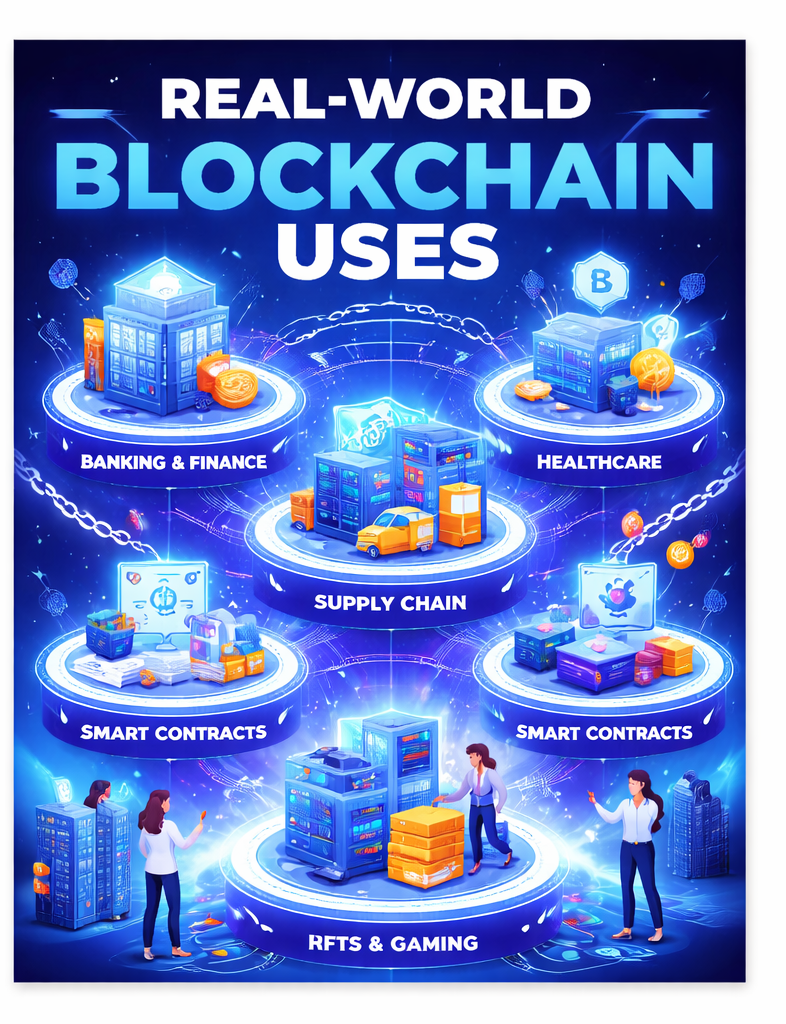
Real-World Uses of Blockchain Technology
Many people still believe blockchain only exists for cryptocurrency trading.
But honestly, blockchain applications now go far beyond Bitcoin.
Today, blockchain technology is solving real-world problems in multiple industries.
That’s why businesses and governments are investing heavily in blockchain development.
Let’s look at where blockchain is already making an impact.
Cryptocurrency and Digital Payments
This is the most well-known blockchain use case.
Cryptocurrencies like Bitcoin and Ethereum use blockchain to record transactions securely.
Blockchain allows users to send digital assets directly without relying on banks.
Benefits include:
- Faster transfers
- Lower fees
- Global accessibility
- Increased transparency
This is what introduced millions of people to blockchain technology in the first place.
Banking and Finance
Banks are exploring blockchain to improve financial systems.
Blockchain can help with:
- Faster international payments
- Fraud reduction
- Smart contract automation
- Secure transaction verification
Many financial institutions now see blockchain as a tool for improving efficiency rather than competing against it.
This is a major part of the growing decentralized finance movement.
Healthcare and Medical Records
Healthcare systems manage huge amounts of sensitive data.
Blockchain can help secure patient records while improving data sharing between hospitals and healthcare providers.
Benefits include:
- Better data security
- Reduced record tampering
- Faster access to patient history
- Improved transparency
This is one reason blockchain in healthcare continues gaining attention worldwide.
Supply Chain Management
Supply chains often struggle with tracking products accurately.
Blockchain allows businesses to monitor products from manufacturing to delivery.
For example, companies can track:
- Food shipments
- Luxury products
- Medicine distribution
- Electronic goods
This improves transparency and helps reduce counterfeit products.
Supply chain tracking is one of the fastest-growing blockchain applications today.
NFTs and Digital Ownership
NFTs became extremely popular because blockchain can verify digital ownership.
NFT stands for Non-Fungible Token.
These tokens prove ownership of digital assets like:
- Art
- Music
- Videos
- Gaming items
Without blockchain, proving ownership of digital content becomes difficult.
Blockchain creates a secure ownership record that cannot easily be copied or changed.
Smart Contracts
Smart contracts are one of the most powerful blockchain innovations.
A smart contract is a digital agreement that automatically executes once certain conditions are met.
For example:
- Automatic payments
- Rental agreements
- Insurance claims
- Business contracts
This reduces paperwork and removes middlemen from many processes.
That’s why smart contracts are becoming increasingly important in blockchain development.
Why Real-World Blockchain Adoption Keeps Growing
Blockchain solves real problems.
That’s the main reason adoption continues increasing.
Businesses want systems that are:
- Secure
- Transparent
- Fast
- Reliable
- Efficient
Blockchain offers all of these benefits in one technology.
And we’re still only seeing the beginning of its full potential.
Advantages of Blockchain Technology
Some people think blockchain is just another tech trend that will disappear.
But the growing adoption across industries suggests otherwise.
The reason blockchain keeps expanding is because it offers several real advantages over traditional systems.
Let’s look at the biggest benefits of blockchain technology.
Better Security
Blockchain uses advanced encryption and decentralized verification systems.
This makes unauthorized data changes extremely difficult.
Every transaction gets verified and permanently recorded inside the blockchain network.
That’s why blockchain security is considered one of its strongest advantages.
Businesses handling sensitive data especially value this protection.
Faster Transactions
Traditional financial systems can sometimes take days to process transactions.
Blockchain often speeds this process up significantly.
Without multiple intermediaries slowing things down, blockchain transactions can happen much faster.
This is especially helpful for international transfers.
Speed is one reason blockchain technology explained simply often attracts businesses looking for efficiency improvements.
Lower Costs
Middlemen usually increase operational costs.
Banks, payment processors, and third-party services all charge fees.
Blockchain reduces reliance on intermediaries.
This can lower transaction costs and administrative expenses.
For businesses, that can mean major long-term savings.
Improved Transparency
Blockchain creates transparent and traceable records.
Every verified transaction becomes part of the blockchain ledger system.
This transparency helps improve accountability and trust.
Industries like finance, healthcare, and logistics benefit heavily from this feature.
Reduced Fraud Risks
Because blockchain records become difficult to alter, fraud becomes harder to commit.
The system’s immutability helps protect information from manipulation.
This is especially valuable for:
- Financial records
- Legal agreements
- Identity verification
- Supply chain tracking
Blockchain data storage creates stronger trust between users and organizations.
No Need for Middlemen
Traditional systems often require third parties to approve transactions.
Blockchain allows direct peer-to-peer interaction.
This creates faster and more efficient systems.
Removing middlemen can improve both speed and affordability.
That’s a major reason decentralized finance continues growing globally.
Better Data Protection
Data breaches have become a serious problem worldwide.
Blockchain spreads information across multiple nodes instead of storing everything in one central location.
This reduces the risk of single-point failures.
Businesses looking for secure digital infrastructure are increasingly exploring blockchain solutions because of this.
Why Blockchain’s Advantages Matter Long-Term
Blockchain isn’t becoming popular just because of cryptocurrency hype.
Its advantages solve genuine digital problems.
People want systems that are:
- Secure
- Transparent
- Efficient
- Decentralized
- Reliable
Blockchain combines all of these features together.
And as blockchain innovation continues improving, we’ll likely see even more industries adopt the technology in the coming years.
The future of blockchain may still be developing, but its impact on digital systems is already becoming impossible to ignore.
Disadvantages and Challenges of Blockchain
Many people online talk about blockchain like it’s a perfect technology with zero flaws.
That’s simply not true.
While blockchain offers impressive benefits, it also comes with real challenges. Understanding both sides is important if you truly want a complete understanding of blockchain technology explained for beginners.
Like every innovation, blockchain still has limitations that developers and industries are trying to improve.
Let’s look at the biggest challenges blockchain faces today.
High Energy Consumption
One of the biggest criticisms of blockchain involves energy usage.
Some blockchain networks, especially older cryptocurrency blockchain systems like Bitcoin, require massive computing power to verify transactions.
This process is called mining.
Mining uses specialized computers that solve complex mathematical problems to validate blockchain transactions.
The downside?
These systems consume a lot of electricity.
This has created environmental concerns worldwide.
Many people now question whether large-scale blockchain systems can remain sustainable long-term.
The good news is that newer blockchain technologies are already trying to solve this issue with more energy-efficient validation systems.
Scalability Problems
Blockchain networks can sometimes struggle with scalability.
In simple words, scalability means handling large numbers of transactions quickly.
Traditional payment systems like Visa can process thousands of transactions every second.
Some blockchain networks still process transactions much slower.
When network activity increases heavily, users may experience:
- Delayed transaction times
- Higher transaction fees
- Network congestion
This is one reason blockchain scalability remains a major topic in blockchain development today.
Developers continue working on solutions to make blockchain systems faster and more efficient.
Government Regulations and Legal Uncertainty
Blockchain technology is still relatively new.
Because of that, laws and regulations continue changing in many countries.
Governments are still trying to understand how blockchain, cryptocurrencies, and decentralized finance should be regulated.
This uncertainty creates challenges for businesses and investors.
For example:
- Some countries support blockchain innovation
- Others heavily restrict cryptocurrency use
- Tax rules differ worldwide
- Legal frameworks remain unclear in some regions
This legal uncertainty can slow blockchain adoption across industries.
Technical Complexity for Beginners
Let’s be honest.
Blockchain can feel confusing at first.
Terms like:
- Nodes
- Hashes
- Smart contracts
- Consensus mechanisms
- Wallets
…can overwhelm beginners quickly.
That’s why many people search for phrases like:
- “blockchain explained simply”
- “easy way to understand blockchain”
- “beginner friendly blockchain tutorial”
The technology itself is powerful, but the learning curve can still discourage many users.
This is one area where better education and simpler blockchain guides are helping new users understand the technology more comfortably.
Slow Adoption in Some Industries
Even though blockchain innovation is growing, many industries still move slowly when adopting new technologies.
Large organizations often hesitate because of:
- High setup costs
- Technical challenges
- Employee training needs
- Security concerns
- Regulatory uncertainty
Traditional systems are deeply connected to many businesses already.
Switching to blockchain infrastructure takes time, money, and planning.
That’s why blockchain adoption continues growing gradually rather than instantly replacing older systems.
Security Risks Still Exist
Many people assume blockchain is impossible to hack.
That’s another myth.
Blockchain network security is very strong, but no system is 100% immune to risks.
Problems can still happen through:
- Poorly designed smart contracts
- Weak crypto wallets
- Human error
- Phishing attacks
- Exchange hacks
In many cases, users themselves become the weakest security point rather than the blockchain system itself.
So while blockchain security is impressive, users still need to stay careful online.
Why These Challenges Matter
Understanding blockchain disadvantages is important because it gives a realistic picture of the technology.
Blockchain is not magic.
It’s a powerful digital system with both strengths and weaknesses.
The good news is that blockchain development continues improving rapidly.
Many current problems are already being addressed through:
- Faster blockchain networks
- Better energy efficiency
- Improved blockchain protocols
- Stronger regulations
- Easier user experiences
That’s why many experts still believe blockchain has huge long-term potential despite its current challenges.
Blockchain and Cryptocurrency Connection
One of the biggest misunderstandings online is that blockchain and cryptocurrency are exactly the same thing.
They’re not.
Cryptocurrency is built using blockchain technology, but blockchain itself has many uses beyond digital coins.
Think of it like this:
Blockchain is the technology.
Cryptocurrency is one application of that technology.
Understanding this difference is important if you truly want to understand blockchain basics.
How Blockchain Supports Cryptocurrency
Cryptocurrencies like Bitcoin and Ethereum use blockchain as their foundation.
Blockchain records every cryptocurrency transaction securely and transparently.
Without blockchain, cryptocurrencies wouldn’t work properly.
For example:
When someone sends Bitcoin to another person, the blockchain network:
- Verifies the transaction
- Confirms ownership
- Records the payment permanently
- Prevents double spending
This is why cryptocurrency blockchain systems became revolutionary.
They allowed digital transactions without needing banks or centralized payment companies.
Bitcoin — The First Major Blockchain Use Case
Bitcoin was the first successful real-world blockchain application.
It introduced millions of people to decentralized finance and blockchain technology.
Bitcoin solved a major digital problem:
How can people send digital money securely without trusting a central authority?
Blockchain solved that issue through transparency, decentralization, and verification.
That’s why Bitcoin remains one of the most recognized blockchain examples globally.
Ethereum and Smart Contracts
Ethereum expanded blockchain technology beyond simple payments.
It introduced smart contracts.
Smart contracts are self-executing digital agreements stored on the blockchain network.
These contracts automatically perform actions when conditions are met.
For example:
- Sending payments automatically
- Releasing funds after delivery
- Executing agreements without lawyers or intermediaries
Ethereum helped show that blockchain applications could go far beyond cryptocurrency transfers.
Not Every Blockchain Uses Cryptocurrency
This surprises many beginners.
Not all blockchain systems involve cryptocurrency.
Many businesses use private blockchain systems simply for:
- Data security
- Supply chain tracking
- Record management
- Identity verification
These systems may never involve digital coins at all.
That’s why blockchain technology explained simply should never focus only on crypto.
Blockchain has much broader potential.
Why Cryptocurrency Made Blockchain Famous
Even though blockchain has many uses today, cryptocurrency gave the technology global attention.
Bitcoin introduced the idea of decentralized digital money.
That created massive interest in blockchain innovation worldwide.
Since then, developers have continued discovering new blockchain use cases across industries.
Without cryptocurrency, blockchain may never have gained this level of global recognition so quickly.

Common Blockchain Myths Explained
There’s a lot of misinformation online about blockchain.
Some people think blockchain is dangerous.
Others think it’s impossible to understand.
And some believe it only exists for criminals or cryptocurrency traders.
Let’s clear up some of the biggest myths.
Myth 1: Blockchain Is Only for Bitcoin
This is probably the most common myth.
Yes, Bitcoin uses blockchain.
But blockchain applications go far beyond cryptocurrency.
Today blockchain is used in:
- Healthcare
- Banking
- Supply chain management
- Digital identity systems
- Smart contracts
- Voting systems
Blockchain technology has become much larger than cryptocurrency alone.
Myth 2: Blockchain Is Illegal
Blockchain itself is not illegal.
Different countries simply have different regulations around cryptocurrency usage.
Many governments and companies actively invest in blockchain development today.
In fact, some banks and major corporations already use blockchain systems internally.
Myth 3: Blockchain Is Impossible to Hack
Blockchain security is extremely strong, but no technology is completely invincible.
The blockchain system itself is difficult to manipulate, but users can still face risks through:
- Weak passwords
- Scam websites
- Phishing attacks
- Unsafe exchanges
So blockchain is highly secure, but users still need smart online safety habits.
Myth 4: Blockchain Is Too Complicated
Honestly, blockchain sounds harder than it actually is.
Once someone explains blockchain in simple words, the core idea becomes easier to understand.
At its heart, blockchain is simply a secure shared digital record system.
That’s why beginner-friendly blockchain tutorials are becoming more popular online.
People want easy ways to understand blockchain without technical confusion.
Myth 5: Blockchain Has No Real-World Value
This myth is becoming weaker every year.
Major companies worldwide now explore blockchain innovation because it solves real business problems.
Blockchain improves:
- Transparency
- Security
- Efficiency
- Data protection
- Transaction speed
That’s why adoption continues growing across industries globally.
Future of Blockchain Technology
Some people think blockchain is just another temporary tech trend.
But many experts believe we’re still only at the beginning.
The future of blockchain looks incredibly promising because industries continue discovering new ways to use the technology.
Let’s explore where blockchain may be heading next.
Blockchain and AI Integration
Artificial Intelligence and blockchain could become a powerful combination.
AI systems rely heavily on data.
Blockchain can help secure and verify that data transparently.
This could improve:
- Data accuracy
- AI decision transparency
- Digital identity verification
- Secure automation systems
Many tech companies are already exploring this combination.
Growth of Web3 and Decentralized Internet
Web3 is one of the biggest blockchain trends today.
The idea behind Web3 is creating a more decentralized internet where users control their own data instead of giant tech companies.
Blockchain technology plays a major role in making this possible.
This could reshape:
- Social media
- Online payments
- Digital ownership
- Internet privacy
Web3 remains early, but interest continues growing rapidly.
Digital Identity Systems
Blockchain may help create safer digital identity systems in the future.
Instead of storing identity data in centralized databases, blockchain could allow users to securely control their own digital identities.
This could reduce:
- Identity theft
- Fraud
- Unauthorized data access
Governments and businesses are already researching these possibilities.
Government and Enterprise Adoption
More governments and companies continue exploring blockchain solutions every year.
Industries showing strong blockchain interest include:
- Banking
- Healthcare
- Logistics
- Real estate
- Insurance
As blockchain development improves, adoption may accelerate even faster.
Expansion of Decentralized Finance
Decentralized finance, often called DeFi, is growing rapidly.
DeFi uses blockchain technology to provide financial services without traditional intermediaries.
This includes:
- Lending
- Borrowing
- Payments
- Trading
- Savings systems
Many experts believe DeFi could become one of blockchain’s biggest long-term use cases.
Why the Future Still Looks Bright
Blockchain still faces challenges, but innovation continues moving quickly.
Developers constantly improve:
- Blockchain scalability
- Security
- Speed
- User experience
- Energy efficiency
That’s why many industries remain optimistic about blockchain’s future potential.
The technology may still evolve significantly over the next decade.
But one thing is clear:
Blockchain is no longer just an experiment.
It’s becoming part of the future digital economy.
Beginner Tips to Learn Blockchain Faster
A lot of beginners think learning blockchain requires advanced coding skills.
Thankfully, that’s not true.
You can understand blockchain fundamentals without becoming a software developer.
The key is learning step by step.
Start With Blockchain Basics
Before exploring advanced topics, focus on understanding:
- What blockchain is
- How blockchain works
- What decentralization means
- How blockchain transactions happen
Strong basics make advanced concepts much easier later.
Learn Basic Cryptocurrency Concepts
Because cryptocurrency introduced many people to blockchain, learning crypto basics can help you understand blockchain faster.
Focus on beginner topics like:
- Bitcoin
- Ethereum
- Wallets
- Transactions
- Blockchain verification
You don’t need to invest money to learn these concepts.
Watch Beginner-Friendly Tutorials
Visual explanations often make blockchain easier to understand.
Many people learn faster through videos, animations, and real-world examples.
Search for:
- blockchain explained for beginners
- beginner friendly blockchain tutorial
- blockchain explained with real life examples
These types of resources simplify complicated ideas.
Follow Blockchain News and Trends
Blockchain evolves quickly.
Following industry news helps you stay updated on:
- Blockchain innovation
- Cryptocurrency trends
- New blockchain applications
- Web3 development
- Decentralized finance growth
Learning continuously is important in fast-changing industries.
Practice Using Blockchain Tools Carefully
Hands-on experience helps a lot.
You can safely explore:
- Crypto wallets
- Blockchain explorers
- Test networks
- NFT platforms
Just remember to stay cautious and never invest money you cannot afford to lose.
Frequently Asked Questions (FAQ Section)
What is blockchain in simple words?
Blockchain is a secure digital record system that stores information across multiple computers instead of one central server.
How does blockchain work?
Blockchain works by verifying transactions through a decentralized network and storing verified records inside connected digital blocks.
Is blockchain safe?
Blockchain is considered highly secure because it uses encryption, decentralization, and transparent verification systems.
What is the purpose of blockchain?
The purpose of blockchain is to create secure, transparent, and trustworthy digital record systems without relying on central authorities.
Is blockchain the same as Bitcoin?
No. Bitcoin is a cryptocurrency that uses blockchain technology. Blockchain itself has many other applications beyond cryptocurrency.
Can blockchain be hacked?
Blockchain systems are very difficult to hack, but users can still face risks through scams, weak passwords, and unsafe platforms.
Why is blockchain important?
Blockchain matters because it improves security, transparency, efficiency, and trust in digital systems.
Conclusion — Final Thoughts on Blockchain Explained
Blockchain may sound complicated at first, but once you break it down, the core idea is actually simple.
It’s a secure and transparent way to store and verify digital information without depending entirely on central authorities.
That’s why blockchain technology continues growing across industries worldwide.
From cryptocurrency and banking to healthcare and supply chains, blockchain applications are expanding rapidly.
And while the technology still faces challenges, its potential remains massive.
The internet changed how people share information.
Blockchain may change how people store, verify, and trust information in the future.
So whether you’re learning blockchain for curiosity, investing, business, or career growth, understanding the basics today can help you stay ahead tomorrow.
If you found this blockchain guide helpful, share it with others who want an easy way to understand blockchain technology.





Good bro 👍