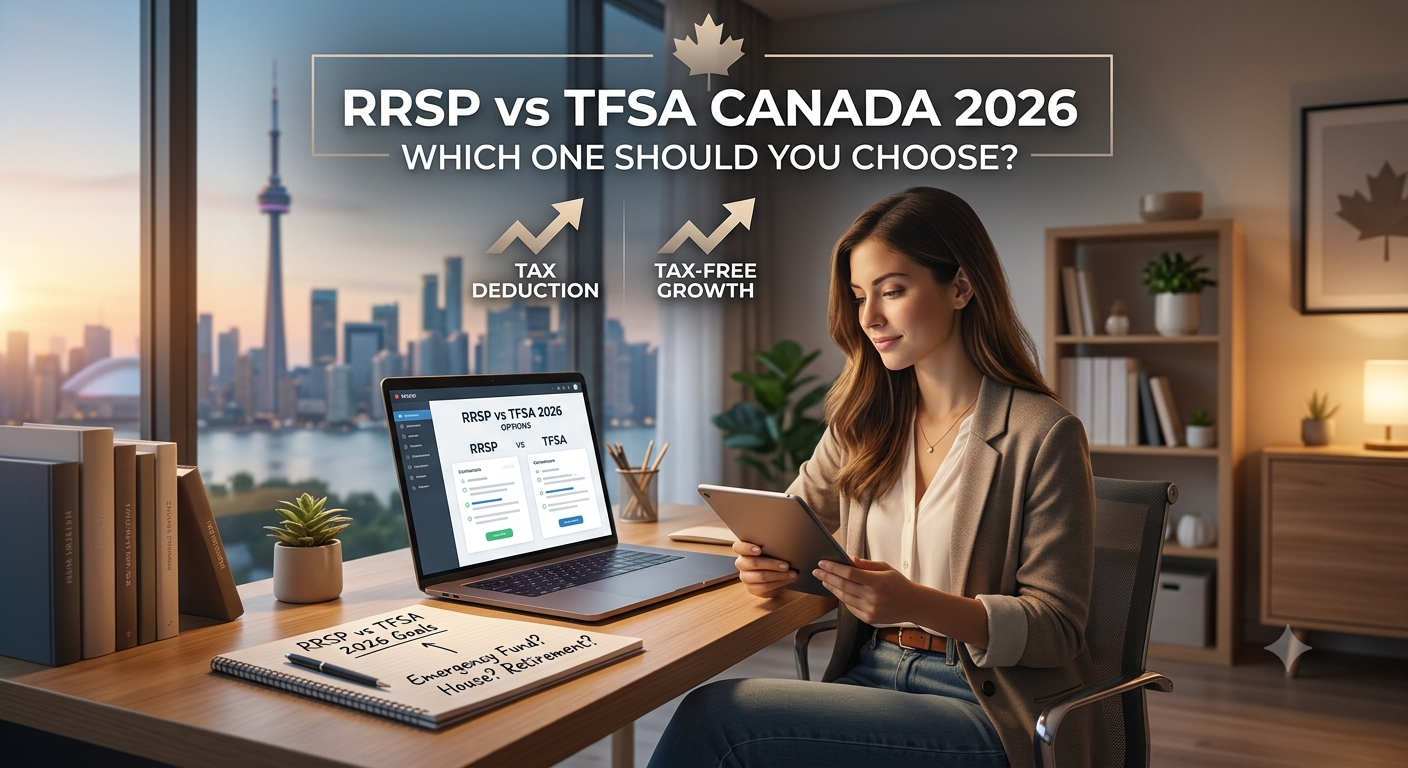

You just got your first full-time job in Canada. Your coworker says to open a TFSA. Your mom says open an RRSP. Now you’re totally confused. Here’s the truth. Figuring out RRSP vs TFSA Canada 2026 is honestly one of the biggest financial roadblocks for young Canadians.
Both of these registered accounts are great for building wealth and cutting down the tax you pay to the Canada Revenue Agency (CRA). But they work in completely opposite ways. Picking the wrong one right now won’t ruin your life. Don’t stress. But choosing the right one could save you thousands down the road.
Want to understand the RRSP vs TFSA difference without drowning in boring financial jargon? You’re in the right place. Let’s break down how these accounts work, the new 2026 limits, and which one to pick based on your goals.
What is an RRSP?
The Registered Retirement Savings Plan (RRSP) is an investment account meant to help Canadians save for their later years. When you put money in, you get a tax deduction for that exact amount. So your taxable income drops. And that usually means a sweet tax refund in the spring.
The money grows tax-free inside. You can buy stocks, bonds, or ETFs. You won’t pay tax on dividends or capital gains while the money stays put. But there is a catch. You pay taxes when you take it out in retirement. The idea is that you’ll probably be in a lower tax bracket later than you are during your peak earning years.
RRSP Contribution Limit 2026
The CRA limits how much cash you can throw into your RRSP. Your RRSP contribution limit 2026 is exactly 18% of the earned income you reported on your 2025 tax return. The absolute max is $33,810.
Got a workplace pension? That will drop your limit a bit due to something called a “pension adjustment.” But here’s the thing — if you don’t max it out this year, that unused room rolls over forever. Just check your CRA My Account to see your exact number.
Who is the RRSP Best For?
Honestly, an RRSP is best if you’re making good money and sitting in a high tax bracket. If you earn over $90,000 or $100,000, that upfront tax break is huge. It’s also perfect if you’re strictly saving for retirement and won’t touch the cash for decades.
What is a TFSA?
The Tax-Free Savings Account (TFSA) started back in 2009. In my view, it’s the most powerful wealth tool Canadians have. Don’t let the word “savings” fool you — it’s an investment account. You can hold stocks, ETFs, and GICs inside it.
Unlike the RRSP, you don’t get a tax deduction when you put money in. You use after-tax dollars. But the massive perk? All the growth is 100% tax-free forever. Even better, when you take money out, you pay zero tax. Pull out $50 or $50,000 — the CRA gets nothing.
TFSA Contribution Room 2026
Every Canadian aged 18 or older gets new space every year. The TFSA contribution room 2026 is set at $7,000.
Just like the RRSP, your unused space carries forward. If you were 18 in 2009 and never put a dollar in, you have a massive $109,000 of room in 2026. Another big perk? If you withdraw money this year, you get that exact contribution room back on January 1st next year. Handy, right?
Who is the TFSA Best For?
This account is absolute gold for RRSP TFSA Canada beginners. If you are early in your career and making a lower income, an RRSP deduction won’t help much anyway. The TFSA gives you crazy flexibility. Use it for your emergency fund, a house down payment, or a tax-free retirement nest egg.
Key Differences Table
Let’s look at the RRSP vs TFSA difference side-by-side to make it clear.
When Should You Choose RRSP?
The TFSA is flexible, but sometimes the RRSP is just the smarter move. Here is when you should focus on it.
1. You Are in a High Tax Bracket
Making over $100,000? You’re paying a lot of tax. Putting cash in an RRSP shaves money off the top of your income. It drops you into a lower bracket. The refund can be massive — and you can reinvest it right away.
2. Your Employer Offers a Matching Program
If your job matches your contributions, take it. Seriously. If they match up to 5%, that’s literally free money. Always get the full match before putting cash anywhere else.
3. You Want to Buy Your First Home
Ever heard of the Home Buyers’ Plan (HBP)? It lets you pull up to $60,000 from your RRSP tax-free for a down payment. You have 15 years to pay it back. It’s a great tool if you want a house soon.
4. You Want to Hold US Dividend Stocks
Here is a quick pro tip. The US charges a 15% withholding tax on dividends for foreigners. But they recognize the RRSP as a retirement account and waive it. TFSAs don’t get this break. So keep your US dividend stocks in your RRSP.
When Should You Choose TFSA?
For a lot of younger Canadians, the TFSA wins hands down. Here is when to max it first.
1. You Are Early in Your Career (Lower Income)
Making around $50,000? An RRSP deduction won’t move the needle much. Your tax rate is already low. Pay the tax now, put it in a TFSA, and let it grow tax-free. Save the RRSP for when your salary bumps up.
2. You Need Flexibility and Access to Cash
Life happens. Cars break down — like my old Honda did last winter — or roofs leak. Pulling cash from an RRSP triggers heavy withholding taxes and kills that room forever. With a TFSA, you can grab your cash anytime for free.
3. You Are Saving for Mid-Term Goals
Planning a wedding, buying a car, or starting a side hustle in the next few years? The TFSA is the perfect holding tank. Put it in safe assets like GICs or cash ETFs, earn a return, and pull it out tax-free.
4. You Expect a Massive Pension
If you work a government job with a rock-solid pension, your retirement income might be high. Funding an RRSP on top of that could push you into a brutal tax bracket later. Building tax-free wealth in a TFSA is much safer here.
Can You Use Both?
Yes. Absolutely. In fact, the ultimate goal is to max out both every year. You don’t have to pick just one forever.
Wondering TFSA or RRSP which is better? Try the “Refund Reinvestment” trick. Put money in your RRSP to get a big tax check from the CRA. Then, instead of buying a new TV or a fancy coffee maker, dump that refund straight into your TFSA.
Or, if you make an average salary, max your TFSA first. Once that $7,000 for 2026 is filled, put the rest in your RRSP. It gives you a perfect mix of tax breaks now and tax-free cash later.
Common Mistakes Canadians Make with RRSP and TFSA
Opening these accounts is easy. But most people get wrong a few major things.
1. Treating the TFSA like a normal savings account
Millions of people leave their TFSA sitting in cash earning 1% interest. Big mistake. A TFSA is an investment bucket. You need to buy ETFs or stocks inside it to get that sweet tax-free growth.
2. Overcontributing
The CRA does not mess around. Go over your TFSA contribution room 2026 and they will slap you with a 1% monthly penalty on the extra amount. Same goes for the RRSP if you go over the $2,000 lifetime buffer. Track your deposits manually because the CRA portal is usually months behind.
3. Withdrawing from an RRSP early
Unless it’s for a home or school, don’t touch your RRSP cash. If you do, the bank holds back up to 30% for taxes immediately. Plus, you lose that contribution room forever. Not worth it.
Final Verdict: RRSP vs TFSA Canada 2026 — Which Is Better?
So, TFSA or RRSP which is better? Honestly, neither is objectively better. It just depends on your life right now.
If you’re a beginner making under $80,000 and want flexibility, the TFSA is your winner. It lets you grow wealth without locking your cash away.
But if you’re a high earner wanting a lower tax bill today — or your job offers a match — grab the RRSP. Figure out your salary, pick the account that fits your life, and let compound interest do its thing.
FAQ Section
1. Can I have multiple TFSA and RRSP accounts?
Yes, you can open accounts at different banks or apps. But your total limit stays the same. Opening a second account doesn’t double your room.
2. What happens if I don’t use my RRSP contribution room?
It rolls over indefinitely. You never lose it. You can save that room for a future year when your income is higher to get a much bigger tax break.
3. Do TFSA withdrawals count as income?
Nope. TFSA withdrawals are entirely tax-free. They don’t count as taxable income, so they won’t mess with government benefits like OAS or EI.
4. When is the RRSP contribution deadline for 2026?
You get the first 60 days of the next year to claim it on your 2026 taxes. So the hard deadline is March 1, 2027.
5. Can I transfer money from my TFSA to my RRSP?
Sure can. You can pull money from your TFSA tax-free and dump it right into your RRSP, assuming you have the room. You’ll get the TFSA space back next January and get a tax deduction for the RRSP side.
This article is for informational purposes only and does not constitute financial advice. Please consult a certified financial advisor before making investment decisions.
More Article : LINK